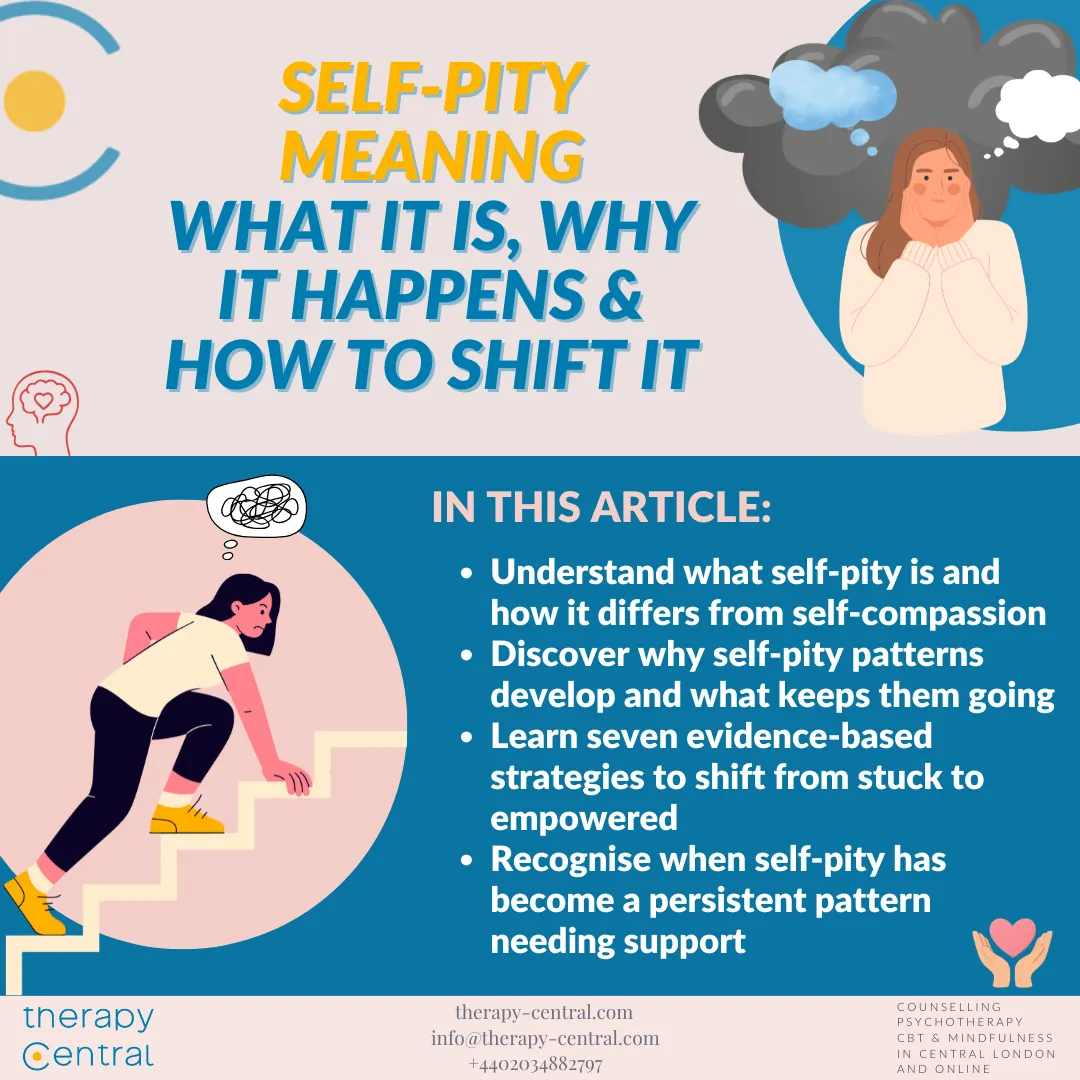

We’ve all had those moments when life feels particularly unfair. Setbacks pile up. Everything feels heavy. You replay painful moments and ask yourself, “why does this always happen to me?”
If that sounds familiar, you’re experiencing something psychologists call self-pity – a pattern that’s both understandable and surprisingly changeable.
Understanding self-pity isn’t about adding shame to an already difficult experience. It’s about recognising a thinking pattern many of us fall into, learning why it happens, and discovering practical ways to shift toward something more helpful – whether that involves building self-esteem or developing healthier coping strategies.

What Is Self-Pity? Understanding the Psychology
Self-pity is when you find yourself dwelling on your struggles while feeling powerless to change them. It differs from healthy sadness by keeping you stuck in a victim mindset rather than moving toward problem-solving. Understanding this pattern is the first step to shifting it.
From a psychological perspective, self-pity involves three interconnected elements: a focus on your own suffering, a sense of being uniquely afflicted or unfairly treated, and a feeling of helplessness about making things better. You’re not imagining your difficulties – they’re real. But self-pity keeps you circling around the problem rather than moving through it.
Think about it this way: healthy sadness acknowledges pain and then asks “what do I need?” Self-pity acknowledges pain and then asks “why me?” That subtle shift in question changes everything about how you respond.
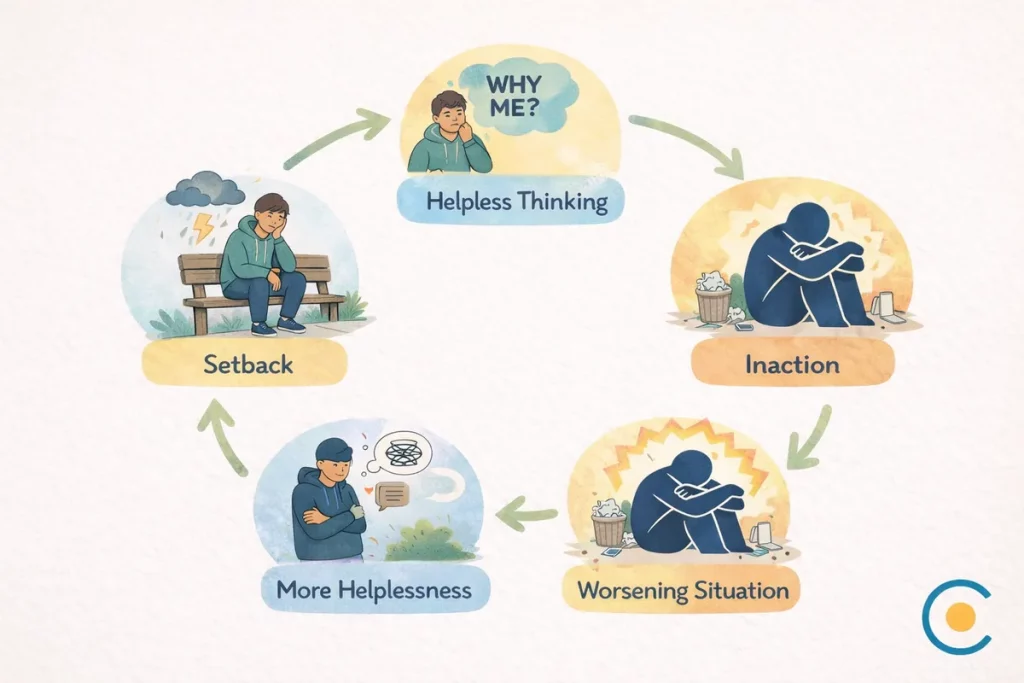
Psychologists sometimes describe self-pity as a form of rumination – repetitive thinking that focuses on distress without leading to solutions 1. Your brain gets caught in a loop: noticing the problem, feeling overwhelmed, reinforcing the belief that you can’t cope, and then noticing the problem again. It’s exhausting, and it’s surprisingly common.

Why Do We Fall into Self-Pity? Common Causes & Triggers
Recognising self-pity in yourself can feel uncomfortable, but awareness is strength, not weakness. Understanding why this pattern emerges helps you respond with curiosity rather than judgment.
Life Experiences That Set the Stage
Self-pity doesn’t appear out of nowhere. It often has roots in earlier experiences where you felt genuinely helpless – childhood situations where you had little control, relationships where your needs went unmet, or repeated experiences of being overlooked. Your brain catalogued the evidence until ‘powerless’ stopped being a fear and started feeling like a fact.
If you’ve faced genuine obstacles – financial stress, health challenges, relationship difficulties – it’s understandable that you might start to feel like life is happening to you rather than with your involvement.
The Psychology Behind the Pattern
From a cognitive perspective, self-pity often involves several thinking traps:
- Learned helplessness: When we face repeated situations we can’t control, our brains learn to stop trying, even when circumstances change and control becomes possible again 2.
- Selective attention: you notice evidence that supports the “nothing works for me” narrative whilst filtering out contradictory evidence.
- All-or-nothing thinking: you view setbacks as total failures rather than normal ups and downs.
- Personalisation: you assume negative events are specifically about you rather than recognising broader circumstances.
Emotional Exhaustion and Stress
Sometimes self-pity emerges simply because you’re worn out. When you’re chronically stressed, your brain’s problem-solving capacity diminishes, and dwelling on difficulties becomes more tempting than taking action. Self-pity can also serve as a temporary emotional buffer: feeling like a victim hurts, but it can feel safer than facing the anxiety of trying and potentially failing again.
The Difference Between Self-Pity and Self-Compassion
This distinction matters enormously, because mixing them up can keep you stuck in patterns that don’t serve you.
Self-Compassion: Your Ally in Difficult Times
Self-compassion, as researcher Kristin Neff describes it, involves treating yourself with the same kindness you’d offer a good friend who’s struggling 3. It includes three elements:
Self-kindness: being warm rather than harshly critical when you face difficulties.
Common humanity: recognising that suffering is part of the shared human experience, and you’re not alone in struggling.
Mindfulness: holding painful feelings in balanced awareness rather than over-identifying with them.
Self-compassion validates your struggle whilst motivating action. It says: “This is genuinely hard. What do I need right now?” Research consistently shows that higher self-compassion is associated with lower anxiety, depression, and stress 4.
Self-Pity: The Well-Meaning Trap
Self-pity, in contrast, validates your struggle whilst reinforcing helplessness. It says: “This is genuinely hard. There’s nothing I can do. Poor me.”
The key difference isn’t in acknowledging difficulty; both approaches do that. The difference lies in what comes next. Self-compassion opens doors; self-pity closes them.
You might be asking yourself: is what I’m experiencing normal? Here’s a framework that might help you get clarity:
| Aspect | Self-Pity | Self-Compassion | Healthy Sadness |
|---|---|---|---|
| Focus | “Why is this happening to me?” | “This is hard; what do I need?” | “This situation is painful.” |
| Mindset | Victim; powerless | Agent; capable with support | Acceptance; temporary |
| Self-Talk | “I always fail; nothing works.” | “I’m struggling; that’s human.” | “I feel sad; this will pass.” |
| Action | Rumination; stuckness | Problem-solving; support-seeking | Processing; moving through |
| Outcome | Increased isolation; helplessness | Growth; connection | Emotional release; resilience |
A CBT Exercise: The Self-Compassion Reframe
When you notice self-pity arising, try this simple reframe:
- Name the thought: “Nothing ever works out for me.”
- Add common humanity: “Many people experience setbacks; I’m not uniquely flawed for struggling.”
- Ask: “What do I need right now to take care of myself, even in a small way?”
This isn’t about forcing positivity. It’s about gently redirecting from rumination to possibility.

Signs You Might Be Stuck in a Self-Pity Pattern
Recognising these patterns isn’t about self-judgment; it’s about building awareness so you can choose differently.
Thinking Patterns to Notice
Do you often find yourself:
- Comparing your struggles to others’ successes and concluding life is unfair specifically to you?
- Hearing your internal voice declare “nothing ever works” or “I always fail” – not as passing worry, but as settled truth that closes down options before you even consider them?
- Replaying difficult situations repeatedly without moving toward solutions?
- Feeling that you’re uniquely burdened whilst others have it easier?
- Dismissing your own agency with phrases like “there’s nothing I can do” or “it won’t make a difference”?
Emotional and Behavioural Signs
Self-pity often shows up through:
- Chronic complaining: sharing difficulties with others but rejecting their suggestions or support.
- Passive stance: waiting for circumstances to change rather than taking small steps.
- Isolation: withdrawing from people who might offer practical help or different perspectives.
- Resentment: feeling bitter toward others who seem to have easier lives.
- Exhaustion: feeling exhausted by problems, yet none of that energising sense you get from actually solving something.
The “Why Me?” Question
Perhaps the clearest sign is the question that loops through your mind: “Why does this always happen to me?” This question, whilst understandable, keeps you focused on unfairness rather than possibility.
The Hidden Costs: How Self-Pity Impacts Your Well-Being
Understanding what self-pity costs you can provide motivation for change – not through shame, but through clarity.
Impact on Mental Health
Self-pity and depression often overlap, though they’re not identical. Depression involves persistent low mood and biological changes, whilst self-pity is primarily a thinking pattern. However, chronic self-pity can worsen depressive symptoms by:
- Reinforcing hopelessness and helplessness – core features of depression.
- Reducing behavioural activation – you do less, which worsens mood.
- Increasing rumination – repetitive negative thinking linked to depression severity.
- Eroding self-efficacy – your belief in your ability to cope.
Anxiety can also intensify. When you feel powerless, uncertainties feel more threatening because you doubt your capacity to handle them.
Mental health challenges are more common than you might think. Mind UK’s 2024 report found that 1 in 5 people aged 8-25 in England reported living with a probable mental health problem, with 2.8 million referrals to adult community mental health services in 2023-24 5. Understanding that you’re not alone in struggling can help reduce the stigma around seeking support.
Relationship Consequences
Your partner offers suggestions, sits with you through another difficult evening – and you dismiss every offer with “that won’t work.” Eventually, they stop offering. Not because they stopped caring, but because caring feels futile when nothing lands.
Self-pity can turn conversations one-sided, leaving friends and partners feeling like sounding boards rather than genuine connections. Vulnerability requires both acknowledging struggles and working together on them; self-pity acknowledges struggles whilst pushing away joint effort.
Physical and Practical Effects
Chronic self-pity takes a physical toll. Rumination keeps your stress response activated, affecting sleep, energy, and motivation for self-care. You might notice difficulty sleeping, physical tension, or procrastination on matters that could improve your situation.
Self-Fulfilling Patterns
Perhaps the most painful cost is how self-pity creates the very outcomes you fear. If you believe nothing will work, you’re less likely to try. When you don’t try, nothing changes, which confirms your belief that you’re powerless.
When does self-pity shift from understandable to something needing attention? Here’s a framework:
| Mild/Occasional | Moderate | Seek Professional Help |
|---|---|---|
| Temporary response to setback | Recurring pattern (weekly+) | Persistent daily pattern (weeks/months) |
| Self-corrects within days | Impacts mood but functional | Impairs work/relationships/self-care |
| Responsive to self-help strategies | Partially responsive to self-help | Unresponsive to self-help efforts |
| No other symptoms | May co-occur with low mood | Co-occurs with depression/anxiety symptoms |
If you’re in the right-hand column, reaching out to a therapist isn’t an admission of failure; it’s recognition that entrenched patterns often benefit from professional support 6.

How to Shift from Self-Pity to Empowered Action: 7 Strategies
Moving away from self-pity isn’t about forcing positivity or dismissing genuine difficulties. It’s about gently redirecting your energy toward what you can influence. The first step is simpler than you might think.

Strategy 1: Catch the Pattern (Cognitive Awareness)
You can’t change what you don’t notice. Start paying attention to self-pity as it arises, without judgment.
Awareness creates a gap between the automatic thought and your response. In that gap, choice becomes possible.
How to apply it: When you notice yourself dwelling on unfairness or feeling powerless, simply label it: “I’m having self-pitying thoughts right now.” You’re not stopping the thoughts, you’re recognising them as thoughts rather than facts. This gentle noticing is the foundation of cognitive change.
Strategy 2: Challenge Helpless Thinking (Cognitive Restructuring)
Self-pity thrives on absolutes: “nothing works,” “I can’t,” “always,” “never.” These thinking traps feel true but rarely withstand gentle questioning. Cognitive Behavioural Therapy research shows that identifying unhelpful thinking patterns reduces their power 7 8.
How to apply it: Instead of “I always fail,” try “This attempt didn’t work. What could I try differently?” Instead of “Nobody cares,” ask “Is that completely true?” You’re not denying difficulty; you’re questioning the helpless interpretation.
Strategy 3: Take Micro-Actions (Behavioural Activation)
When you feel powerless, even tiny actions rebuild your sense of agency. Send a two-line text to a friend. Step outside for ten minutes. The action matters less than proving to yourself: I can still choose. I still have agency, even when it’s tiny. Psychologists call this behavioural activation: taking small actions generates evidence that contradicts helplessness.
Strategy 4: Practice Self-Compassion (Emotional Rebalancing)
Remember, everyone struggles. You’re not uniquely flawed for finding life difficult. Treat yourself with the kindness you’d offer a friend.
Self-compassion research shows it reduces rumination, anxiety, and depression whilst increasing resilience and motivation 9.
How to apply it: When you notice harsh self-criticism (“I’m such a failure”), pause and ask: “What would I say to a friend in this situation?” Then offer yourself that same understanding. Place your hand on your heart, take a few slow breaths, and say quietly: “This is hard. I’m doing my best. It’s okay to struggle.”
Strategy 5: Shift from “Why Me?” to “What Now?” (Reframing)
The question you ask determines where your attention goes. “Why me?” searches for unfairness. “What now?” searches for possibilities.
How to apply it: When you catch yourself asking “why is this happening to me?”, gently redirect: “Okay, this is the situation. What’s one small thing I could do now?” You’re not dismissing the difficulty, you’re moving from passive suffering to active engagement.
Strategy 6: Seek Support, Not Just Sympathy (Relational Shift)
There’s a difference between sharing struggles to connect and seek help versus complaining to confirm your helplessness. Genuine support-seeking generates practical assistance and new perspectives; complaint without openness to change reinforces isolation.
How to apply it: Ask yourself: “Am I sharing this to connect and get help, or to confirm that nothing will work?”

Strategy 7: Build Agency Through Small Wins (Self-Efficacy)
Self-efficacy – your belief in your capacity to influence outcomes – is the antidote to helplessness 10. Each small success builds evidence that you can cope and create change.
How to apply it: Set achievable goals: not “be completely happy” but “do one thing today that takes care of future me.” Keep a simple log of daily wins, even “I got out of bed when I didn’t want to.” You’re training your brain to notice capability.
Maintaining Progress
Shifting away from self-pity is a process, not a one-time event. Expect setbacks without catastrophising – days when self-pity resurfaces are normal, not failure. Build your support network with people who encourage growth without enabling helplessness. And schedule regular self-compassion check-ins: weekly, ask “How have I been treating myself? With kindness or harshness?”
Your Next Step
Moving from self-pity to empowered action is entirely possible, and you don’t have to do it alone. Our integrative, evidence-based care draws from CBT, acceptance and commitment therapy, compassion-focused therapy, and mindfulness practices. We tailor what we use to what you need.
Whether you’re struggling with persistent self-pity patterns, depression, anxiety, or simply feeling stuck, our qualified and experienced therapists and psychologists are here to help. We offer flexible session times from early morning to late evening, including weekends, to fit your schedule. Book a free 15-minute consultation to explore how therapy might support you.
FAQ
Is self-pity the same as feeling sorry for yourself?
Yes, they’re essentially the same. Both describe dwelling on difficulties while feeling powerless. The key distinction is whether you remain stuck (self-pity) or use the feeling as motivation to seek support and make changes. If you’re looking for practical ways to break this cycle, our guide on how to stop feeling sorry for yourself offers evidence-based strategies.
Why do I keep falling into self-pity even when I know it's unhelpful?
Self-pity can become a learned pattern – your brain finds temporary relief in avoiding responsibility, so it reinforces the habit. It feels easier in the moment than facing difficult emotions or making hard changes. You’re not weak for falling into it; you’re human.
Can self-pity be a symptom of depression?
Self-pity often overlaps with depression but isn’t the same. Depression involves persistent low mood and biological changes, while self-pity is a thinking pattern. However, chronic self-pity can worsen depressive symptoms, creating a difficult cycle.
How is self-compassion different from self-pity?
Self-compassion validates your struggle while motivating action; self-pity validates your struggle while keeping you stuck. Self-compassion says “this is hard, what do I need?” Self-pity says “this is hard, I’m helpless.” The first empowers, the second paralyses.
What should I do when I notice I'm stuck in self-pity?
Acknowledge the feeling without judgment, then gently redirect. Ask yourself: “What small step could I take right now?” Even tiny actions – reaching out to a friend, taking a walk – shift you from victim mode to agency.
When should I seek professional help for self-pity patterns?
If self-pity persists despite self-help efforts, impacts your relationships or work, or co-occurs with depression or anxiety symptoms, therapy can help. CBT is particularly effective at identifying and reshaping these thinking patterns; you don’t have to navigate this alone.