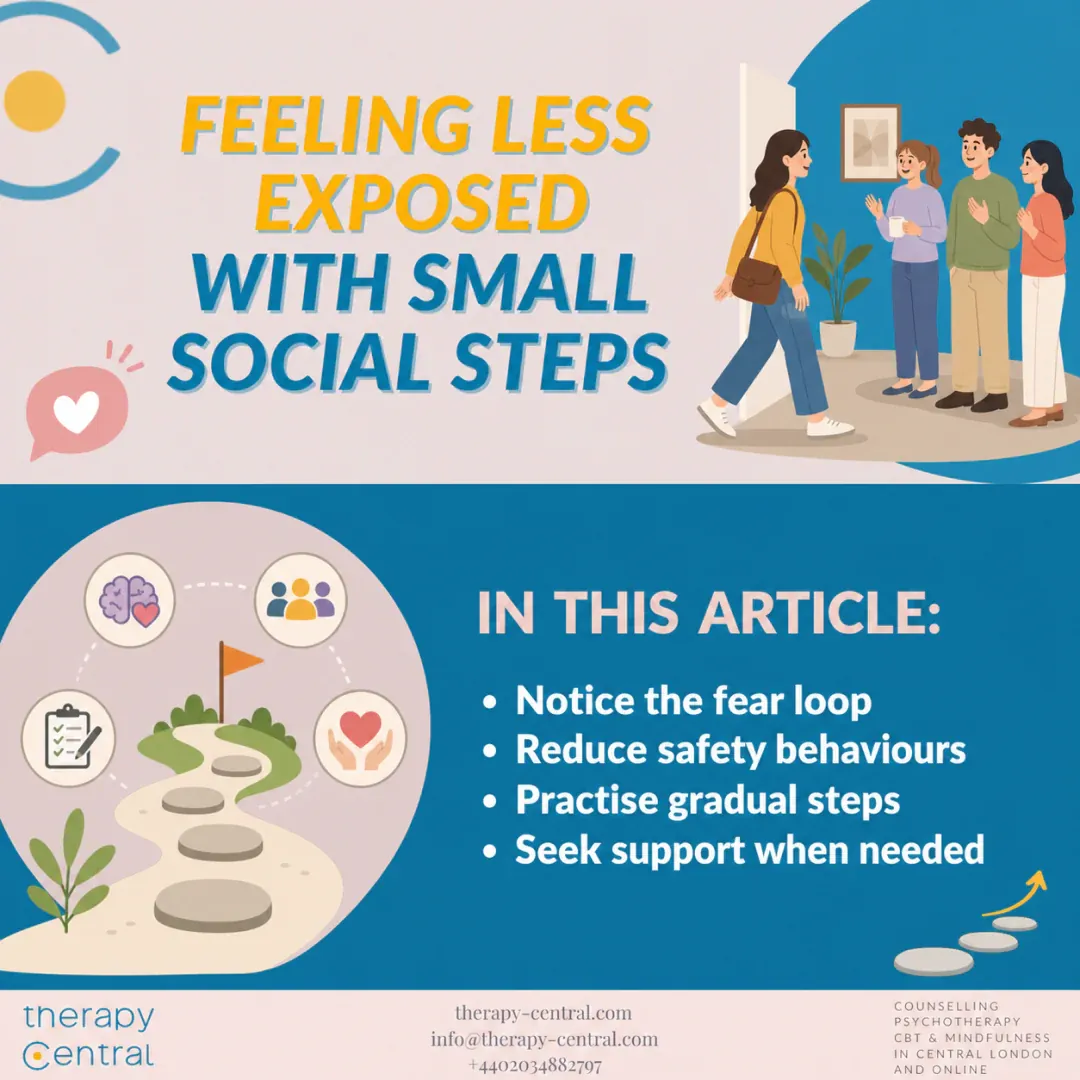

There is a particular kind of tiredness that comes from feeling watched even when nobody has said anything unkind. You get through the meeting, the dinner, the seminar, the date, or the group chat, then spend the journey home replaying one sentence as if it has become evidence against you.
Learning how to overcome social anxiety starts with understanding why ordinary contact can feel so exposing.
Social anxiety can make the smallest social moments feel overlit. Your voice, face, hands, pauses, messages, silence, and choice of words can all feel as though they are being inspected. This guide is about changing that loop gradually to have more room to act, connect, and recover when anxiety is present.
How Can You Overcome Social Anxiety?
You can overcome social anxiety gradually by understanding the fear-of-judgement loop, reducing avoidance and safety behaviours, practising small social steps, and getting therapy support when anxiety is limiting your work, relationships, study, or daily life.
“Overcome” can sound as though anxiety has to vanish before life can open up again. Most people do not change that way. Progress is usually more ordinary: you spot the prediction your mind is making, notice the things you do to stay safe, and test one small alternative often enough that your nervous system starts to update.
That might mean speaking once in a meeting rather than trying to sound impressive. Or it might mean staying at a gathering for twenty minutes instead of leaving as soon as your body gets loud. It might also look like sending a message after one reread, then letting the discomfort rise and fall without turning it into a trial.
What Social Anxiety Can Feel Like From The Inside
Social anxiety is often described as a fear of being judged, watched, embarrassed, or rejected 1. And that is true, but the lived experience is usually less neat.
You may be talking to someone while another part of you is checking your face, breath, posture, tone, eye contact, and whether the pause was too long. It can feel as if you are both in the conversation and standing outside it, grading yourself in real time.
For some people, the anxiety begins before the situation. A meeting on Thursday starts taking up room on Monday. A friend’s birthday dinner becomes a mental rehearsal of where to sit, what to say, how to leave, and whether people will notice you are tense. For others, the hardest part comes afterwards, when the mind replays the event and turns tiny moments into accusations 2.
Common signs include:
- worrying for hours or days before social situations;
- avoiding events, meetings, calls, groups, or conversations;
- feeling tense, hot, shaky, nauseous, blank, or breathless around people;
- watching yourself closely while speaking;
- assuming others can see more anxiety than they probably can;
- replaying conversations afterwards;
- relying on alcohol, over-preparation, silence, or escape routes to get through.
This monitoring is protection, rather than vanity. Your mind is trying to prevent humiliation, rejection, or exclusion. The problem is that the protection can become so intense that it creates the very distance you were trying to avoid.
Why Avoidance Can Keep Social Anxiety Going
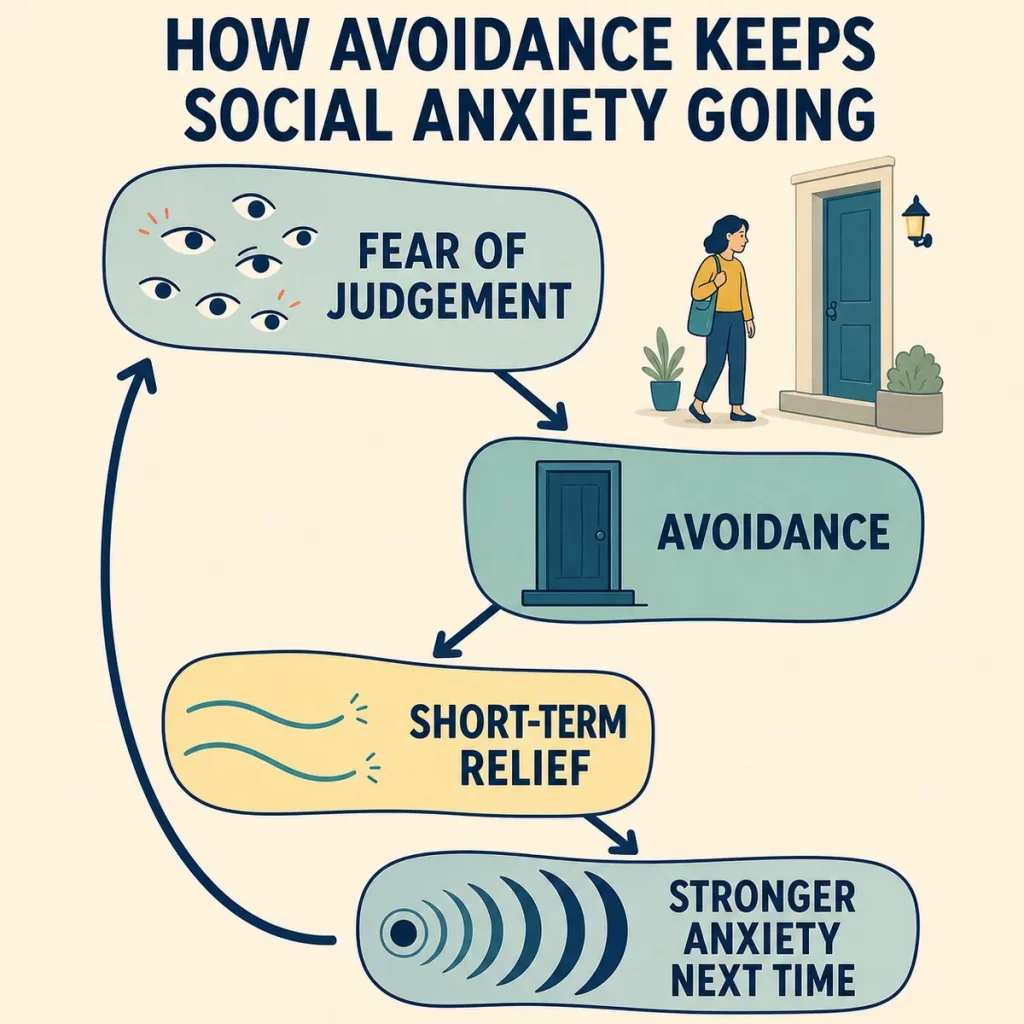
Avoidance makes sense in the moment. If a room feels unsafe, not entering it brings relief. If a message feels risky, not sending it removes uncertainty. If a meeting feels exposing, staying silent can feel like the only way to get through.
The relief is real, which is why the pattern can become so convincing. The brain learns, “I survived because I avoided that.” Next time, the same situation carries extra weight. The party is not just a party now; it is the thing you escaped last time. The phone call is not just a phone call; it is the thing your body has already labelled as too much.
This is where social anxiety starts taking up practical space. One cancelled plan becomes the reason you are not invited next time. One silent meeting becomes the role people expect from you. One avoided date becomes a story about not being ready. This has nothing to do with weakness. Your threat system has just learned a rule that now needs updating.
That learning usually comes through small, repeatable experiences. You do not need to flood yourself. You only need enough contact with the feared situation for your body to discover that discomfort can rise, peak, and pass without avoidance doing all the work.
Safety Behaviours And Self-Monitoring
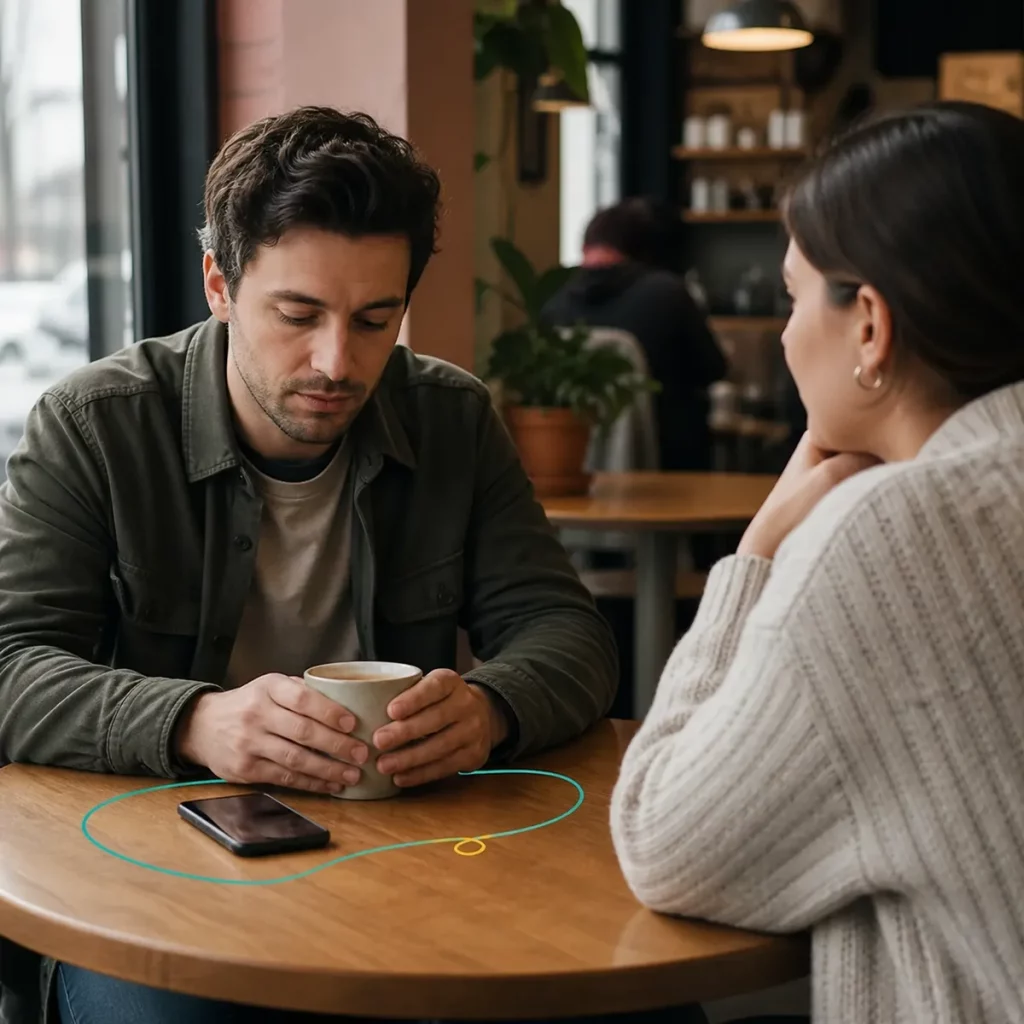
Safety behaviours are the small protective habits people use to feel less exposed. They might look harmless from the outside: rehearsing a sentence, staying near the door, asking questions while rarely sharing anything, or holding a cup to keep your hands busy. They can also include checking your face, planning every topic, or keeping your phone ready as an exit.
The function they serve is understandable. They offer control. They reduce the chance of a visible mistake. They make the situation feel less open-ended. The cost is that they can stop you from discovering what would happen without them.
If you only cope by saying very little, you may leave believing silence kept you safe. If you only cope by planning every line, you may never find out whether an imperfect answer would have been accepted. If you spend the conversation checking yourself, you may miss the other person’s warmth, interest, or awkwardness as well (most people are carrying some of their own) 3.
| Situation | Safety Behaviour | Short-Term Relief | Long-Term Cost | Small Experiment |
|---|---|---|---|---|
| Meeting at work | Rehearsing one sentence repeatedly | Feels more controlled | Harder to listen or respond naturally | Prepare one point, then let one response be spontaneous |
| Seeing friends | Staying quiet or asking only questions | Less chance of saying the wrong thing | Others know less about you | Share one small opinion or update |
| Eating or drinking in public | Watching your hands closely | Feels safer | Increases self-consciousness | Notice the room for ten seconds, then return to eating |
| Sending a message | Rewriting it many times | Reduces uncertainty briefly | Makes ordinary contact feel high-stakes | Reread once, send, and resist checking for five minutes |
| Dating or meeting someone new | Planning every topic | Fewer silences | Less room for genuine connection | Allow one pause without filling it immediately |
You do not need to drop every safety behaviour at once. Choose one small experiment. If you usually rehearse for thirty minutes, rehearse for ten. If you avoid eye contact completely, glance at the person’s face at natural moments. If you always leave early, stay five minutes longer and notice what your anxiety predicts compared with what happens. The discomfort may rise first; that does not mean the experiment has failed.
How To Take Small Social Steps
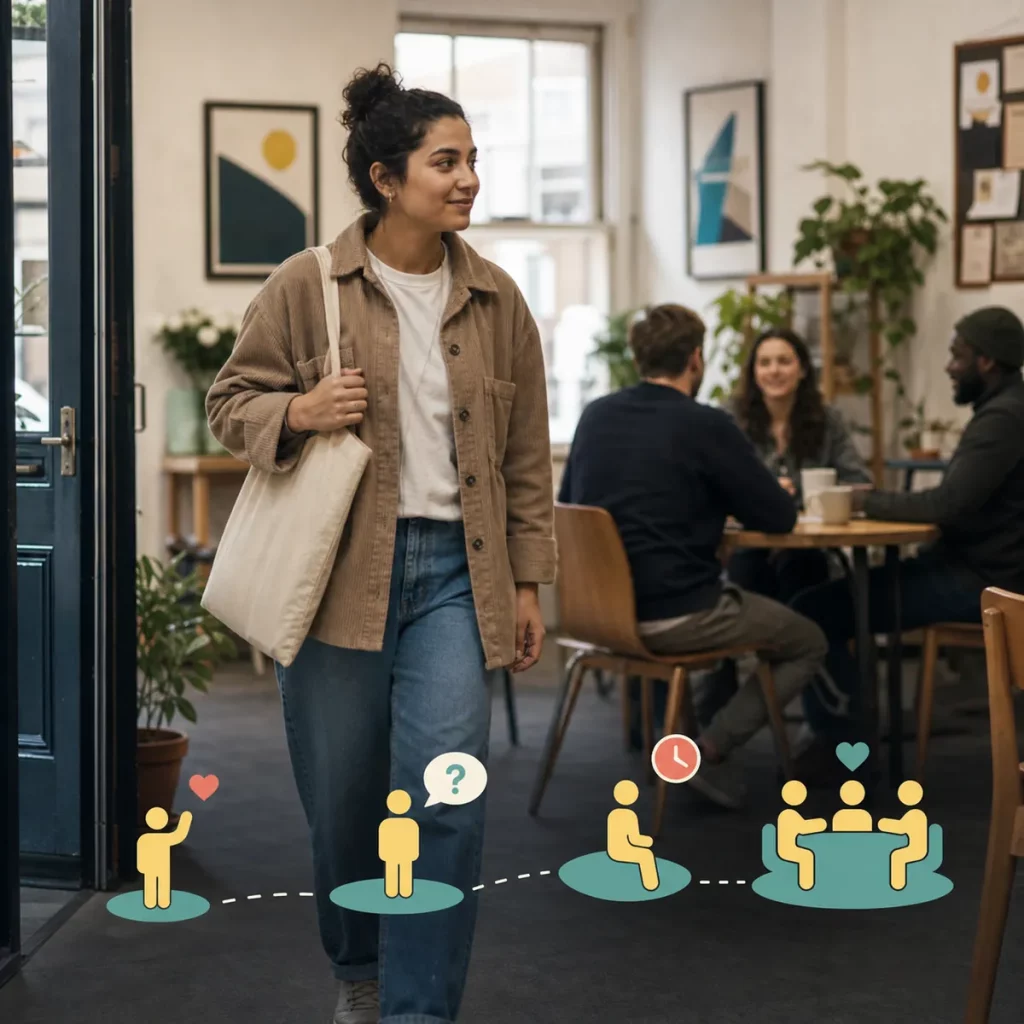
Small social steps work best when they are specific, repeatable, and connected to a life you want to move towards. Fear alone does not make a step useful. A step earns its place when it helps you practise something meaningful: being seen, speaking honestly, asking for something, tolerating a pause, or staying present with another person.
Try building a ladder of situations from easier to harder.
Lower rungs might include saying hello to a neighbour, making brief eye contact with a shop assistant, or sending a voice note to a trusted friend. You might also reply to a message without polishing it for too long.
Middle rungs might include joining a work lunch, making a short phone call, contributing once in a small group, or attending a class.
Higher rungs might include dating, presenting, going to an event where you know few people, or having a direct conversation you would usually avoid.
For each step, write down:
- what you are afraid will happen;
- what you usually do to feel safer;
- what you will reduce this time;
- where you will place your attention instead;
- what you learned afterwards.
It can help to make the step almost boringly concrete. “Talk more at work” is too big to practise. “Ask one follow-up question in Tuesday’s meeting” gives your mind a clear task and gives you something fair to review afterwards.
The last part is easy to skip, but it is where change often consolidates. Social anxiety reviews the awkward evidence automatically. A more useful review would ask what you predicted would happen, what actually happened, what you coped with, and what you might try next.
How To Work With Fear Of Judgement
Fear of judgement often arrives as a sentence that sounds certain:
They will think I am strange. I will blush and everyone will notice. I will have nothing to say. I will sound stupid. They will decide I am boring.
The mind treats these predictions as warnings, but all they really are is guesses informed by anxiety loops.
You do not have to win an argument with every thought. Sometimes the more useful move is to make the prediction concrete enough to test. “Everyone will judge me” is too broad. “If I pause for two seconds, the other person will look irritated” is something you can watch for. Once the fear is specific, you can design a small experiment.
If your fear is that pauses are unacceptable, allow one natural pause without rushing to fill it. If your fear is that you must script everything, prepare the main point and let the wording be ordinary. If your fear is that people can see your anxiety, notice whether they actually respond to you as if something terrible is happening.
This is not about proving that nobody ever judges anyone. People are imperfect; sometimes a conversation really is clumsy. The more useful learning is that awkwardness is usually survivable, often forgettable, and rarely the full story of who you are.
How CBT Or Therapy Can Help
CBT approaches often work with the connection between thoughts, body sensations, attention, and behaviour 4 5. In social anxiety, that can mean identifying feared predictions, reducing safety behaviours, testing assumptions, and building a more flexible response to being seen.
Good therapy should not turn exposure into a dare. The work should be paced. You and the therapist might map the situations you avoid and notice the rules you are living under. From there, you can design experiments together that are challenging enough to teach your brain something new without overwhelming you 2.
If social anxiety is limiting your relationships, work, study, or everyday life, social anxiety therapy can offer structured support. It can help you understand the fear loop and practise gradual change with a therapist.
Therapy can be especially useful when you understand the problem intellectually but your body still reacts as if ordinary social contact is dangerous. That gap between insight and felt safety is often where guided practice may help 6.
Social Anxiety At Work, Study, Friendships And Dating

Social anxiety is not limited to dramatic situations. It often lives in the ordinary moments that other people may not realise are difficult.
At work, it might mean reading an email several times before sending it, staying silent when you have a useful point, or leaving a meeting convinced your face gave you away. In study settings, it may mean skipping seminars, avoiding group work, or knowing the answer but feeling unable to raise your hand.
In friendships, social anxiety can look like taking too long to reply because the reply has started to feel like a performance. It can mean cancelling plans, not because you do not care, but because the build-up has become too heavy by 5pm. In dating, it can make every pause feel like evidence and every delayed message feel like rejection.
The practical question is: where is anxiety asking me to disappear, and what would be one small way to remain present?
Social Anxiety, Shyness And Performance Anxiety
Shyness, introversion, performance anxiety, and social anxiety can overlap, but they are not identical.
Shyness may mean you warm up slowly. Introversion may mean you need time alone to recharge. Neither is a problem by itself. The difficulty begins when fear, rather than preference, starts deciding what you can do.
Performance anxiety may centre on being watched during a task, such as speaking, presenting, or performing. Social anxiety can include those moments, but it often reaches further into ordinary contact: chatting before a meeting, replying to a message, eating with people, or letting someone get to know you.
Social anxiety is usually broader and more restrictive. It can affect conversations, groups, work, dating, friendships, public places, messages, and everyday interactions. It is less about preference and more about fear, avoidance, and the sense that being seen is dangerous.
The practical point is that the goal is not to become extroverted. As a quieter person, you can still have a full social life if you reduce the fear and avoidance that stop you from acting according to your values.
When To Seek Support

It may be time to seek support when social anxiety is no longer just uncomfortable, but organising your choices. That might mean turning down work opportunities, missing study, avoiding dating, relying on alcohol to socialise, cancelling plans often, or spending hours replaying conversations that other people have probably moved on from.
Support can also help when you have tried to manage social anxiety alone and keep meeting the same wall. Many people can explain the fear loop perfectly and still freeze, hide, over-prepare, or withdraw when the moment arrives. That does not mean the insight in itself was useless, but the next stage may need practice, structure, and review.
At Therapy Central, we can work with you on the specific situations that have become too heavy. We can help you understand what your anxiety is trying to prevent and plan gradual practice that does not ask you to perform confidence before you have built it.
If social anxiety keeps deciding what you do, we can help you plan gradual practice and work out what support fits. Contact us for a free 15-minute consultation.
FAQ
Can social anxiety go away?
Social anxiety can reduce significantly with gradual practice, support, and time. Some people still feel anxious in certain situations, but they become less ruled by avoidance, self-monitoring, or fear of judgement.
How do I calm social anxiety in the moment?
Slow your breathing, notice your surroundings, soften self-monitoring, and focus on the conversation or task. The aim is not instant calm, but staying present enough to take the next small step.
Is social anxiety just shyness?
Shyness can feel uncomfortable, but social anxiety is usually more persistent, distressing, and restrictive. It often involves fear of scrutiny, avoidance, and worry before or after social situations.
What are safety behaviours in social anxiety?
Safety behaviours are things you do to feel less exposed, such as rehearsing sentences, avoiding eye contact, checking your face, or staying quiet. They can help briefly but keep the fear loop active.
Can CBT help social anxiety?
CBT can help by identifying feared predictions, reducing safety behaviours, and testing new ways of acting in social situations. Therapy can pace this gradually so the work feels manageable.
Should I force myself into social situations?
Usually, no. Helpful practice is gradual and planned. It should stretch you a little, not overwhelm you. Small repeated steps tend to work better than pushing yourself too hard.