
You’re about to share an idea in a meeting when a voice whispers: What if they think it’s stupid? You change your outfit three times, imagining strangers’ judgments. You say yes to plans you don’t want, terrified someone might think you’re difficult.
That voice in your head? It’s exhausting. It shapes your choices, drains your energy, and keeps you performing for an audience that might not even be watching.
If this feels familiar, you’re not alone. Caring what people think is one of the most common sources of anxiety, and one of the most exhausting.
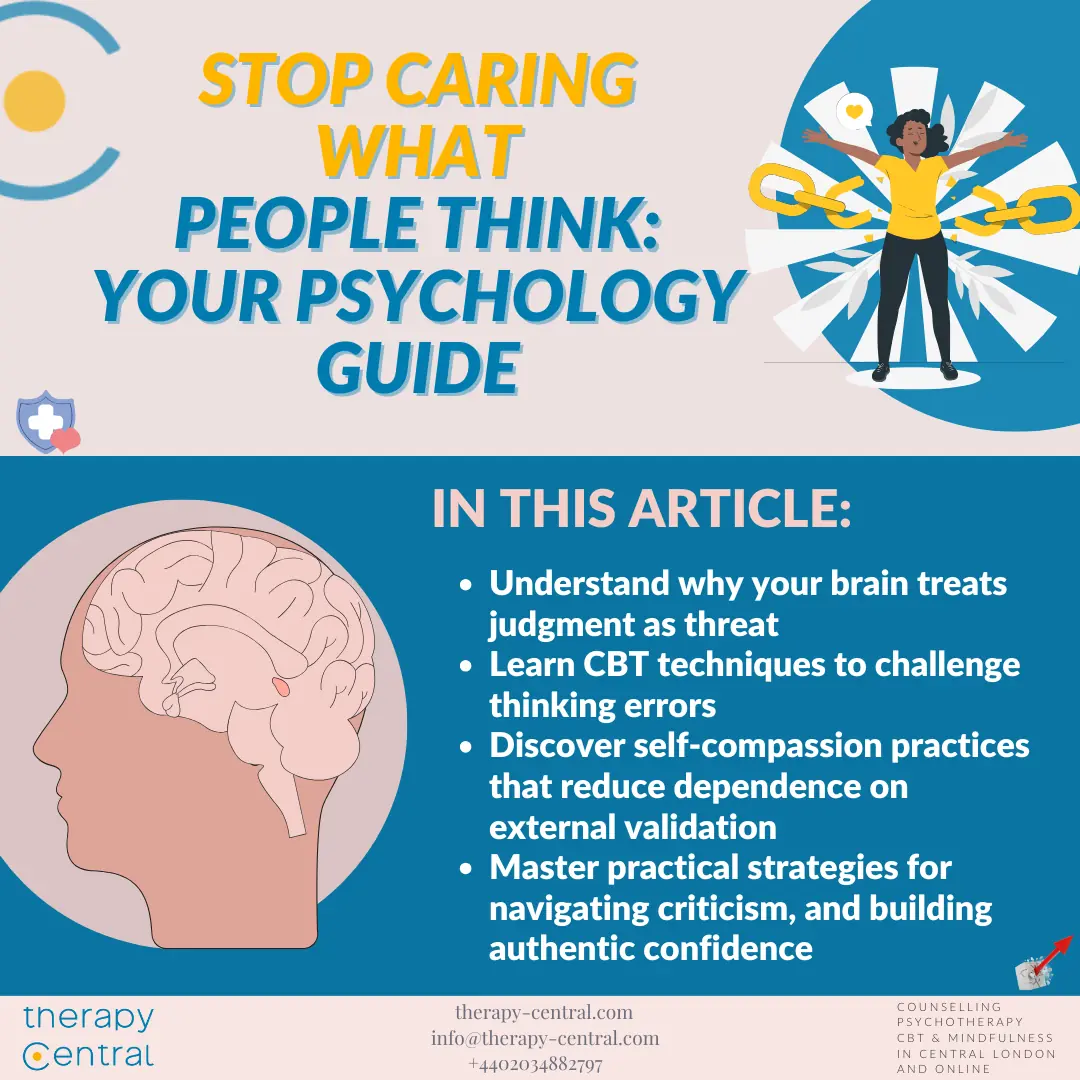
Let’s explore why we care, the mental health cost when concern becomes excessive, and evidence-based strategies to help you stop caring what people think and reclaim authentic confidence.

Why Do We Care What People Think?
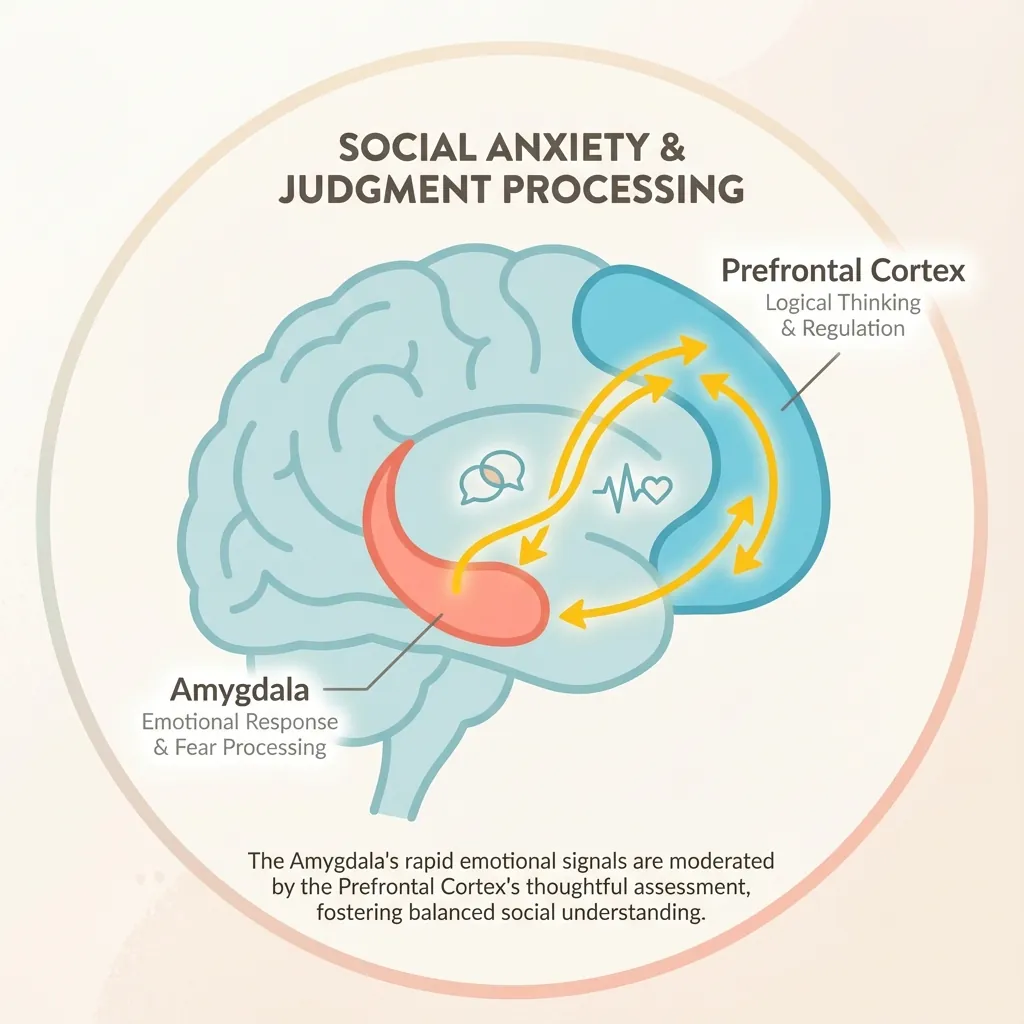
We care what people think because humans evolved as social creatures who relied on group acceptance for survival. Our brains developed threat-detection systems that flag social rejection as danger. Today, this shows up as social anxiety. The amygdala reacts to judgment as if it were a real physical danger, and it triggers fight or flight even when no real danger exists.
Your Brain’s Social Threat Detector
You’re about to speak up in the meeting. Your heart hammers. Your palms go slick. That familiar tightness grips your chest – your body screaming DANGER when the actual risk is… someone might disagree with you.
Your amygdala functions like a smoke alarm that can’t tell steam from fire. When you anticipate criticism, it reacts as if the danger is real. Your heart races, your palms sweat, and your thoughts speed up because your brain thinks it needs to protect you. Neuroscience research shows that social pain activates the same brain regions as physical pain 1. Judgment triggers the same threat response your brain uses for physical danger.
Neuroplasticity means you can retrain these pathways through repeated experiences of surviving judgment 2. Research demonstrates that effective psychological treatment like cognitive behaviour therapy actually normalises excessive neural reactivity in the amygdala.
The Evolutionary Psychology Perspective
For thousands of years, belonging to a group meant access to food, protection, and mates. Exile equalled death 3. Our ancestors who cared deeply about group opinion survived and passed on their genes. But modern life has changed faster than evolution. Disagreeing with a colleague won’t leave you vulnerable to predators, yet your brain still treats social disapproval as catastrophic.
Learned Patterns from Childhood
If you grew up where love felt conditional – earned through achievements or obedience – you learned that acceptance depends on meeting others’ expectations. Perhaps caregivers withdrew affection when you disappointed them, or praised you only when you succeeded.
These experiences wire neural pathways connecting self-worth with external approval. Children who experience criticism, neglect, or inconsistent emotional availability often develop hypervigilance to others’ moods and judgments. These patterns persist into adulthood even when they’re no longer serving you.
So you understand WHY your brain treats judgment as danger. But what happens when that fear takes over your life?
The Mental Health Cost of Caring Too Much About Others’ Opinions
Healthy social awareness – being considerate, reading social cues – supports relationships. But when caring what people think becomes excessive, it crosses into anxiety-driven people-pleasing that erodes your mental health and authentic self-expression.
Understanding Where Healthy Concern Ends and Anxiety Begins
Understanding where you fall on this spectrum can clarify whether your social awareness is healthy or has tipped into anxiety.
The table below highlights key differences between adaptive social sensitivity and anxiety-driven people-pleasing:
| Aspect | Healthy Social Awareness | Excessive People-Pleasing |
|---|---|---|
| Motivation | Respect for others + self-respect balance | Fear of rejection, need for approval |
| Decision-Making | Consider others’ input, make authentic choice | Defer to others’ preferences, suppress own needs |
| Emotional Impact | Occasional discomfort, overall equilibrium | Chronic anxiety, resentment, exhaustion |
| Boundaries | Maintain clear boundaries, say no when needed | Difficulty saying no, porous boundaries |
| Feedback Response | Open to constructive criticism, dismiss unfair judgment | Ruminate on all criticism, catastrophise negative feedback |
| Authenticity | Express genuine opinions tactfully | Hide true self, perform expected persona |
| Relationships | Mutual respect, reciprocity | One-sided, transactional (approval-seeking) |
Occasional people-pleasing? Normal. But when it becomes your default, that’s not healthy social awareness. That’s anxiety running the show.
The Vicious Cycle That Keeps You Stuck
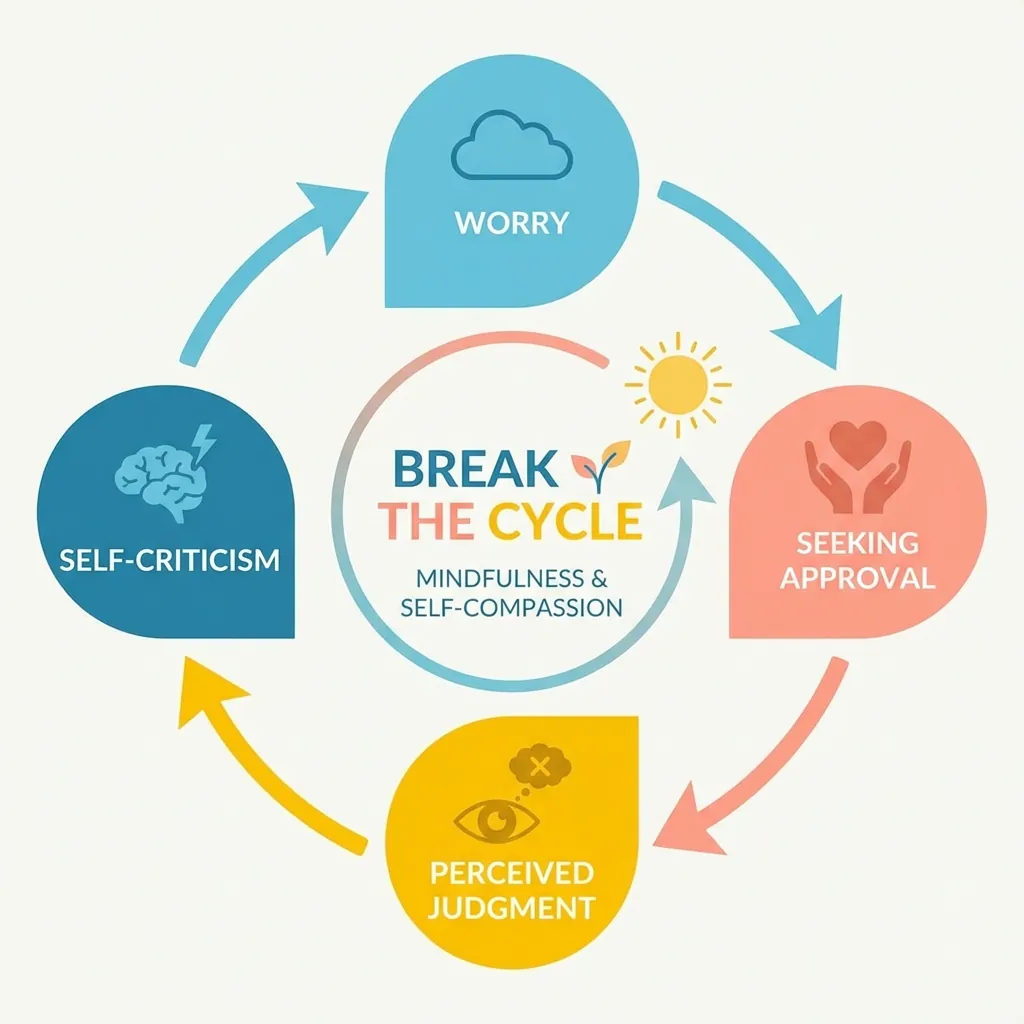
Excessive concern creates a self-reinforcing cycle:
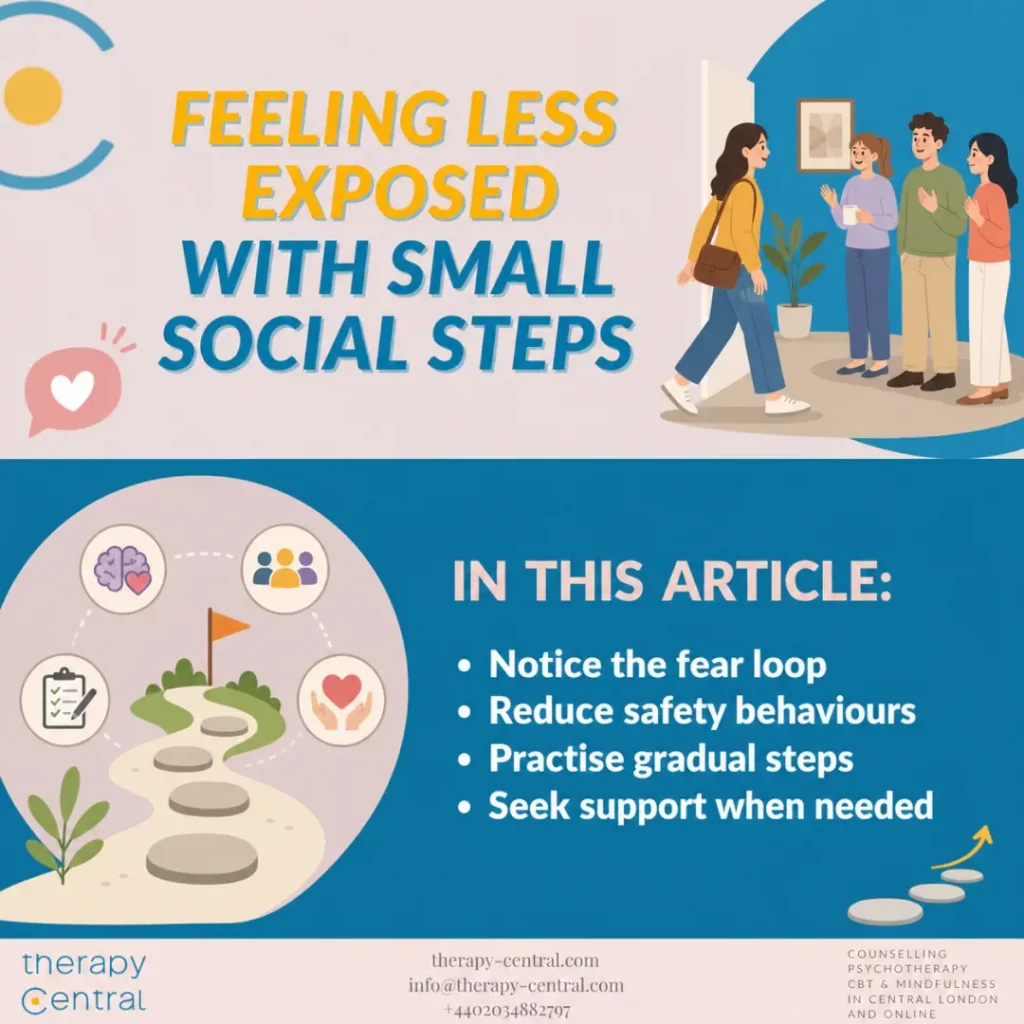
- imagine judgment
- experience anxiety
- avoid the situation
- …and confirm your belief that judgment is dangerous because you never test whether your fears are true.
Avoidance provides short-term relief but strengthens long-term anxiety 4.
Research shows that avoiding what you fear brings quick relief, but it also keeps long-term anxiety in place and strengthens unhelpful thoughts. Each time you dodge a situation, you deny yourself the chance to learn you can survive disapproval, and your world shrinks.
Mental Health Conditions Linked to Excessive People-Pleasing
When caring what people think becomes severe and persistent, it often overlaps with diagnosable conditions:
- Social Anxiety Disorder: Intense fear of social situations where you might be judged, leading to avoidance and significant life interference 5.
- Generalised Anxiety Disorder: Chronic worry including persistent rumination about others’ perceptions.
- Low Self-Esteem and Depression: When self-worth depends entirely on external validation, perceived rejection triggers worthlessness, sometimes spiralling into depression.
- Perfectionism: Holding impossibly high standards to avoid criticism, leading to burnout and paralysing fear of failure.
If you recognise persistent distress or life interference, professional support can make a real difference.
By now, we’ve covered why your brain responds this way and how anxiety maintains the pattern. But understanding alone won’t shift deeply wired responses. You need practical tools that retrain those neural pathways. Let’s look at strategies that actually work.
How to Stop Caring What People Think: Evidence-Based Strategies
The following strategies draw from Cognitive Behavioural Therapy (CBT), Acceptance and Commitment Therapy (ACT), and compassion-focused approaches. These therapeutic frameworks have strong research support for reducing social anxiety and building authentic confidence 6.
Identifying and Challenging Thinking Errors
CBT identifies common thinking errors – automatic thought patterns that fuel anxiety about judgment. Recognising these in your own mind is the first step to challenging them.
Here are five particularly errors relevant to caring what people think:
| Thinking Error | Definition | Example | CBT Reframe |
|---|---|---|---|
| Mind Reading | Assuming you know what others think without evidence | “They’re definitely judging my outfit” | “I can’t read minds. What’s the actual evidence?” |
| Catastrophising | Imagining worst-case scenario as inevitable | “If I speak up, everyone will think I’m incompetent” | “What’s realistic? Even if one disagrees, how likely is disaster?” |
| Personalisation | Taking responsibility for others’ reactions that aren’t about you | “She didn’t smile-I must have offended her” | “Her mood could be about countless factors unrelated to me” |
| All-or-Nothing | Viewing social interactions as total success or complete failure | “I stumbled, so the presentation was a disaster” | “Mistakes happen. The content was solid.” |
| Discounting Positives | Dismissing positive feedback, magnifying criticism | “They only said ‘good job’ to be polite” | “Why assume politeness but not sincerity?” |
Practice this week: Keep a thought record. When you notice anxiety about judgment, write the situation, automatic thought, thinking error, and a balanced reframe. If structured writing doesn’t suit you, you might try mental noting (simply naming the thinking error when it arises) or grounding techniques like focusing on things you can see, hear, and touch.
Testing Your Assumptions Through Behavioural Experiments
Thinking errors stick around because we never test them. The idea of deliberately inviting judgment? Terrifying. But here’s the thing: behavioural experiments work because they gather real evidence about whether your fears are accurate.
Here’s how to start small:
- Identify a specific fear: “If I disagree, everyone will think I’m difficult.”
- Rate belief strength: 0-100% (e.g., 80%).
- Design an experiment: Express a mild disagreement.
- Predict outcome: “Three people will visibly disapprove.”
- Conduct it: Actually do it.
- Observe objectively: Notice actual reactions – not anxiety’s interpretation.
- Re-rate belief: Often belief drops significantly after seeing most people engage neutrally.
Each experiment demonstrates that feared outcomes rarely occur, and when they do, you cope better than anticipated 7.
Building Internal Validation: Grounding Self-Worth in Your Values
You perform brilliantly. Someone nods approval; relief floods through you. But then they seem distracted the next day, and panic sets in. Was it fake? Did you misread them?
External validation is unreliable because people’s opinions shift constantly and usually have little to do with you. Internal validation roots your self-worth in your own values and integrity.
Values Clarification Exercise: Here’s a simple practice that can help ground you when external validation feels shaky. Think of three values that matter deeply to you. It could be kindness, creativity, honesty, or something entirely different. For each one, recall a recent moment when you lived that value, even if nobody noticed. Can you validate yourself for living according to your principles, regardless of whether anyone acknowledged it?
Choosing Whose Opinions Matter
Not all opinions deserve equal weight. Distinguish between constructive feedback from trusted sources and unconstructive criticism from people who don’t know you. When anxiety arises, ask: “Does this person’s judgment actually matter to me?” If no, consciously let it go.
You’ve learned the cognitive tools – reframing thoughts, testing assumptions, grounding in values. But real change requires something deeper: learning to be kind to yourself when you’re struggling.
Building Authentic Self-Acceptance: Practical CBT Techniques
Self-Compassion Practices
Research shows that self-compassion – treating yourself with the kindness you’d offer a friend – reduces social anxiety and increases resilience 8. It might feel strange at first, especially if you’re used to harsh self-criticism. Try this when judgment anxiety flares:
When you notice the discomfort, place a hand on your heart and acknowledge what’s happening: “This is hard right now.” Then remind yourself this struggle is part of being human; you’re not alone in caring what people think. Thousands of people feel exactly this way in this very moment. Finally, offer yourself the kindness you’d give a friend: “May I be gentle with myself. May I accept where I am.”
This practice counters shame with connection, perspective, and kindness – exactly what you need when that critical voice takes over.

Self-Esteem vs. Self-Compassion: A Critical Distinction
Self-esteem often depends on external validation or performance. When those conditions falter, self-esteem collapses. Self-compassion, by contrast, is unconditional, it doesn’t require perfection or universal approval 9.
Research shows that self-compassion provides stable well-being that doesn’t fluctuate with success and failure the way self-esteem does.
CBT Exercise: Compassionate Letter to Yourself
Write a letter to yourself from the perspective of an unconditionally loving friend. Acknowledge your struggles without criticism. What would this compassionate friend say? Read this letter whenever self-criticism flares.
Exposure to Disapproval: Gradual Desensitisation
Exposure therapy involves gradually facing feared situations to reduce their emotional power 7. CBT with gradual exposure to fear has been found very effective for treating phobias and anxiety, with NICE recommending it as evidence-based treatment. You might work through a structured list like the one below, or take a more flexible approach, like choosing one small step each week that moves you toward authenticity.
Graded Exposure Hierarchy (start small, build gradually):
- Low-level: Express a minor preference (e.g., choose a restaurant).
- Moderate: Share a personal opinion on social media; wear an outfit you worry others might judge.
- Higher: Disagree with a colleague respectfully; decline an invitation without over-explaining.
- Challenging: Pursue a goal others don’t understand; set a firm boundary despite anticipated pushback.
After each exposure, reflect: Did feared judgment occur? If yes, did you cope? Over time, these experiences demonstrate that disapproval isn’t catastrophic.
Navigating Social Situations with Confidence
Handling Criticism at Work
A colleague criticises your project. Your stomach drops. That familiar voice whispers: Everyone thinks I’m incompetent.
Pause. Notice that anxiety is interpreting one person’s feedback as universal judgment. Apply the CBT reframe: “This is one person’s perspective. What’s the evidence everyone agrees?” Seek clarification: “Can you help me understand what specifically didn’t work?” This transforms vague judgment into actionable feedback and shows you can engage constructively rather than defensively.
Declining Invitations Without Over-Explaining
People-pleasers often say yes to plans they don’t want, fearing offense. Practice this: “Thanks for the invite! I can’t make it, but I hope you have a great time.” No elaborate excuse, no apology. Respectful honesty is not rude.
Sharing Unpopular Opinions with Friends
You’re in a conversation where everyone agrees on something, but you see it differently. Try: “I see it a bit differently. I think [your perspective].” Notice what happens – often, nothing catastrophic. Each instance builds evidence that your voice has value.

How to Stop Worrying About Others and Focus on Yourself
Chronic rumination about others’ perceptions drains energy that could fuel your own goals. Here’s how to redirect focus:
- Set Values-Based Goals: Instead of “How do I make everyone like me?”, ask “What do I want to create or contribute?” Pursuing meaningful goals naturally shifts attention from external validation to internal purpose.
- Limit Social Comparison: You’re scrolling Instagram. Everyone looks confident, successful, effortlessly happy. Your chest tightens. That’s comparison – social media amplifies judgment anxiety by feeding you highlight reels. Notice when you’re comparing yourself. Consciously redirect: “Their journey isn’t mine.”
- Practice Presence: Mindfulness techniques anchor you in the present rather than anxious future projections. Even two minutes of grounding when anxiety spikes can interrupt rumination.
Focusing on yourself isn’t selfish. It’s reclaiming energy from an exhausting quest for universal approval.
When Professional Support Helps: Recognising the Signs
If you’ve tried self-help strategies and still feel trapped by others’ opinions, professional support can provide the structure and expertise to address deep-rooted patterns.
Signs It’s Time to Seek Therapy
Consider reaching out to a therapist if caring what people think:
- Causes persistent distress dominating your thoughts most days
- Prevents authentic choices, leaving you disconnected from yourself
- Fuels chronic anxiety or depression
- Damages relationships through resentment or inauthenticity
- Results in burnout or exhaustion from constant performing
These patterns aren’t character flaws; they’re learned responses that therapy is designed to help with.
What CBT for Social Anxiety and People-Pleasing Involves
At Therapy Central, our integrative approach draws from evidence-based frameworks tailored to your needs:
- CBT: Identifies and challenges distorted thoughts, tests assumptions through experiments, builds coping strategies 10.
- ACT: Teaches psychological flexibility – accepting uncomfortable feelings while acting according to your values.
- Compassion-Focused Therapy: Develops self-compassion to counter shame and self-criticism.
- Schema Therapy: Explores early experiences that shaped people-pleasing patterns, helping you heal attachment wounds.
Therapy provides a safe space to explore these patterns without judgment (ironically, the freedom from judgment you’re seeking in the wider world).

Accessing Therapy in the UK
Mental health support is more accessible than you might think. NHS Talking Therapies (IAPT) offers free CBT and other evidence-based therapies. You can refer yourself directly through your local service without needing a GP appointment 11. The service is available for ages 18 and over (16+ in some areas) if you’re registered with a GP.
If you’re looking for flexible private options, Therapy Central offers both online and in-person sessions (London-based), with flexible scheduling, including early morning, evening, and weekend appointments. Our qualified and experienced therapists and psychologists provide tailored integrative care, combining CBT, compassion-focused approaches, and other evidence-based methods.
We offer a free 15-minute consultation to discuss your concerns and explore whether therapy might help you.
Three Relapse-Prevention Tips
Learning to care less about others’ opinions isn’t a one-time achievement, it’s an ongoing practice which includes:
- Regular Self-Compassion Check-Ins: Set a weekly reminder to ask, “How have I treated myself this week? When did I prioritise others’ approval over my needs?”
- Celebrating Small Wins: Each time you express an authentic preference, set a boundary, or survive mild disapproval, acknowledge it. Keep a “confidence log” of times you chose authenticity.
- Reconnecting with Your Values: When anxiety ramps up, ask: “What matters to me here? If I weren’t worried about others’ opinions, what would I choose?”

The Balance: Healthy Social Awareness Without People-Pleasing
The goal isn’t complete indifference to others. Healthy social functioning requires some awareness – empathy, consideration, adaptability. What we’re aiming for is balanced self-acceptance: valuing your own judgment while remaining open to constructive feedback. Think of it as recalibrating from “everyone’s opinion determines my value” to “I care about perspectives of people I trust, I’m open to growth, and I know my worth isn’t contingent on universal approval.”
Moving Toward Authentic Confidence
Learning how to not care what people think (or more accurately, how to care less about others’ opinions and more about your own values) is one of the most liberating journeys you can take. It frees energy for pursuits that matter, deepens authentic relationships, and cultivates self-worth that’s stable and internal.
This work takes time. You’re unlearning patterns forged over years. Be patient with yourself. You’ll have days where you share your opinion without spiralling afterwards. And then you’ll have days where one offhand comment sends you back into rumination mode, replaying the interaction for hours. That’s not failure. That’s normal.
If you’re struggling with persistent anxiety about others’ opinions, people-pleasing that’s exhausting you, or social fear that’s limiting your life, you don’t have to navigate it alone. Therapy Central’s qualified and experienced therapists and psychologists are here to support you with evidence-based, compassionate care tailored to your needs. Whether you’re dealing with anxiety that’s affecting your daily life or seeking to build genuine confidence, we offer a free 15-minute consultation to explore how therapy might help – no pressure, just an opportunity to talk.
You deserve to live authentically, with confidence rooted in your own integrity rather than others’ approval. Contact us for a free 15-minute consultation and choose the approach that fits your life.
FAQ
Is it normal to care what people think?
Yes, it’s completely normal. Humans are social beings, and caring about social perception is evolutionarily wired into us. However, when this caring becomes excessive and interferes with your authentic choices or mental well-being, it may benefit from psychological strategies or professional support.
What mental health conditions are linked to excessive people-pleasing?
Social anxiety disorder, generalised anxiety, low self-esteem, perfectionism, and depression commonly involve excessive concern about others’ judgments. Conditions like avoidant personality disorder also feature intense fear of criticism. If these patterns significantly impact your life, speaking with a therapist can help.
Can CBT help me stop caring what others think?
Yes. Cognitive Behavioural Therapy (CBT) is highly effective for challenging distorted thoughts about judgment, testing assumptions through behavioural experiments, and building self-acceptance. CBT therapists work with you to identify thinking errors and develop evidence-based coping strategies that reduce your dependence on external validation.
How long does it take to stop caring about others' opinions?
There’s no fixed timeline; it depends on individual factors like anxiety severity, ingrained patterns, and support systems. Meaningful progress typically emerges within weeks of consistent practice using psychological strategies, but deeper confidence-building is an ongoing process that unfolds over months.
Is not caring what people think healthy?
Complete indifference isn’t the goal – healthy social functioning requires some awareness of others. The aim is balanced self-acceptance: valuing your own judgment while remaining open to constructive feedback. Extreme disregard for all social input can indicate other issues and may benefit from professional exploration.
When should I seek therapy for people-pleasing behaviours?
Consider therapy if caring what others think causes persistent distress, prevents authentic choices, fuels chronic anxiety or depression, damages relationships, or leads to burnout. A qualified therapist can help you explore underlying patterns and develop healthier self-perception through evidence-based approaches like CBT.