
Picture this: a child tidies their room and you respond with genuine praise. Within days, they’re choosing to organise their space more often. Or perhaps you’ve noticed how a simple “thank you” from your partner encourages you to be more attentive in future conversations.
These everyday moments reveal one of psychology’s most powerful principles at work – positive reinforcement, a technique that strengthens behaviour through rewarding consequences rather than punishment or criticism.
Understanding positive reinforcement can transform how we approach behaviour change, whether we’re raising children, building healthier habits, strengthening relationships, or creating more motivating workplaces. Yet despite its effectiveness, this concept is often misunderstood or misapplied. Many people confuse it with bribery, use rewards inconsistently, or focus solely on parenting and miss how powerful this principle is for adult relationships, workplace dynamics, and personal growth.
In this guide, you’ll learn what positive reinforcement really is, how it differs from bribery and punishment, and how to use it in a way that feels natural and respectful.
What Is Positive Reinforcement? Understanding the Psychology
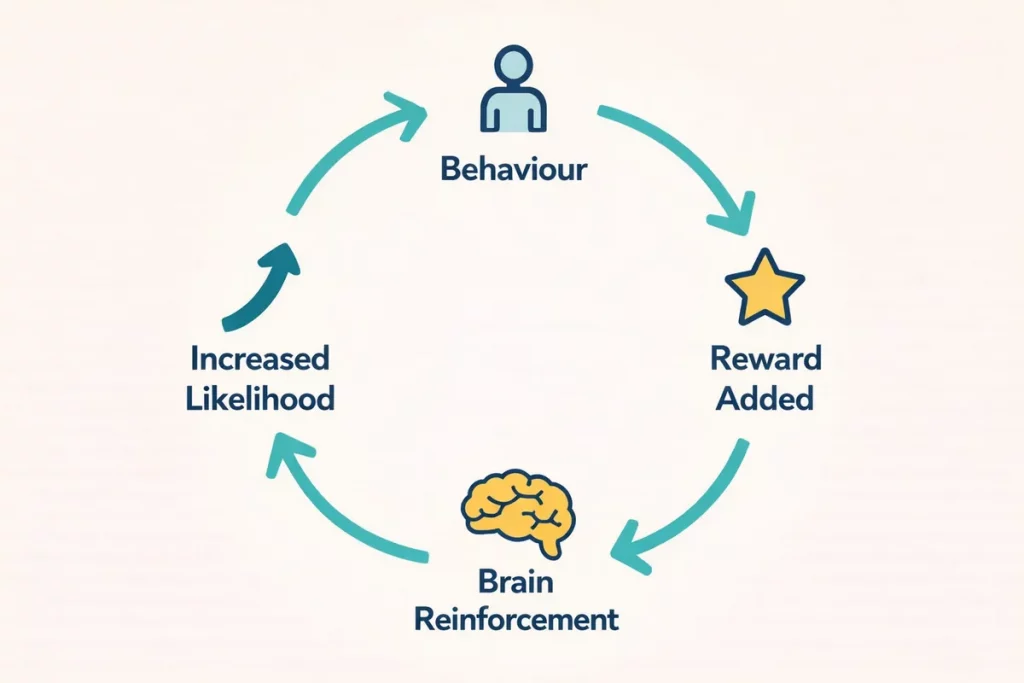
Positive reinforcement works by rewarding a behaviour right after it happens. That reward makes the behaviour more likely to happen again. Examples include praising a child for tidying up or thanking a partner for listening. This evidence-based technique increases the likelihood behaviours will be repeated, making it highly effective for lasting change.
At its core, positive reinforcement is a fundamental principle of operant conditioning, a learning theory developed by psychologist B.F. Skinner in the mid-20th century. The term “positive” doesn’t mean “good” in this context; rather, it refers to adding something (a pleasant stimulus) to the environment. When a behaviour is followed by a rewarding consequence, that behaviour becomes more frequent over time because our brains learn to associate the action with the pleasant outcome.
Think of positive reinforcement as the psychological equivalent of watering a plant. You’re nurturing the behaviours you want to see flourish by providing them with what they need to grow: attention, appreciation, tangible rewards, or enjoyable experiences. This stands in contrast to punishment-based approaches, which attempt to suppress unwanted behaviours through negative consequences but often create anxiety, resentment, and damaged relationships without teaching alternative, constructive behaviours.
The Core Components of Positive Reinforcement
For positive reinforcement to work effectively, several elements must be present:
- A specific behaviour you want to encourage (the “target behaviour”)
- A meaningful reward that the person genuinely values (the “reinforcer”)
- Immediate timing connecting the behaviour and reward (ideally within seconds or minutes)
- Consistency in applying the reinforcement, especially when establishing new patterns.
- Appropriate intensity matching the significance of the behaviour.
Research published by the American Psychological Association demonstrates that immediate, consistent positive reinforcement changes behaviour faster and lasts longer than delayed or inconsistent ones [1]. A 2024 network meta-analysis of online parenting programs found the same pattern. When parents responded to positive behaviour with praise or rewards, children showed the biggest improvements. [10].
This makes intuitive sense. When people clearly see which actions lead to positive outcomes, they feel more motivated to repeat those actions.
Distinguishing Positive Reinforcement from Related Concepts
What positive reinforcement isn’t often matters as much as what it is. Many people confuse it with bribery, permissiveness, or simply “being nice.” However:
- Bribery involves offering rewards before behaviour occurs to coerce compliance, often for inappropriate reasons. Positive reinforcement rewards behaviour after it happens to encourage natural repetition.
- Permissiveness means avoiding boundaries or consequences altogether. Positive reinforcement maintains clear expectations whilst focusing on rewarding desired behaviours rather than punishing unwanted ones.
- Generic praise (“Good job!”) is less effective than specific positive reinforcement (“I noticed you put your dishes in the dishwasher without being asked. Thank you, that’s really helpful”).
Understanding this distinction helps you apply reinforcement principles ethically and effectively, supporting genuine behaviour change rather than manipulation or dependency.
Another common source of confusion is the difference between positive and negative reinforcement. The table below clarifies these two approaches:
| Aspect | Positive Reinforcement | Negative Reinforcement |
|---|---|---|
| Definition | Adding pleasant stimulus to increase behaviour | Removing unpleasant stimulus to increase behaviour |
| Mechanism | Reward is given | Annoyance/discomfort is removed |
| Example (Parenting) | Praising child for tidying room | Nagging stops when child tidies room |
| Example (Workplace) | Bonus for meeting deadline | Micromanagement stops when employee performs well |
| Example (Personal) | Treat yourself after exercising | Guilt/stress reduces after completing task |
| Common Misconception | N/A | Often confused with punishment (which decreases behaviour) |
| Outcome | Behaviour increases due to pleasant addition | Behaviour increases due to unpleasant removal |
Both approaches increase desired behaviours, but positive reinforcement tends to create more positive emotional associations and stronger relationships.

How Positive Reinforcement Works: The Science Behind Behaviour Change
To truly harness the power of positive reinforcement, it helps to understand what’s happening inside your brain when rewards shape behaviour. This knowledge transforms the technique from a simple “carrot and stick” approach into a sophisticated tool grounded in neuroscience and psychology.
The Brain Science Behind Rewards: Your Internal Motivation System
When you engage in a behaviour that produces a rewarding outcome, your brain’s reward circuitry springs into action. The key player here is dopamine, a neurotransmitter often called the brain’s “motivation molecule.” Think of dopamine as your brain’s biological gold star system: it creates the pleasurable sensation that makes you want to repeat behaviours.
Here’s what happens neurologically when positive reinforcement occurs:
- You perform a behaviour (tidying the kitchen, completing a work task, expressing appreciation to your partner)
- A reward follows (praise, a sense of accomplishment, affection, a treat)
- Dopamine is released in brain regions including the ventral tegmental area and nucleus accumbens
- Neural pathways strengthen between the behaviour and the rewarding outcome
- Future motivation increases because your brain now associates that behaviour with pleasure
This process, known as reward-based learning, is the same mechanism that helps us learn everything from basic survival skills to complex social behaviours. Research from neuroscience shows that the anticipation of reward (not just receiving it) triggers dopamine release, which explains why positive reinforcement remains effective even when we know it’s coming [2].
Understanding Reinforcement Schedules: Timing Matters
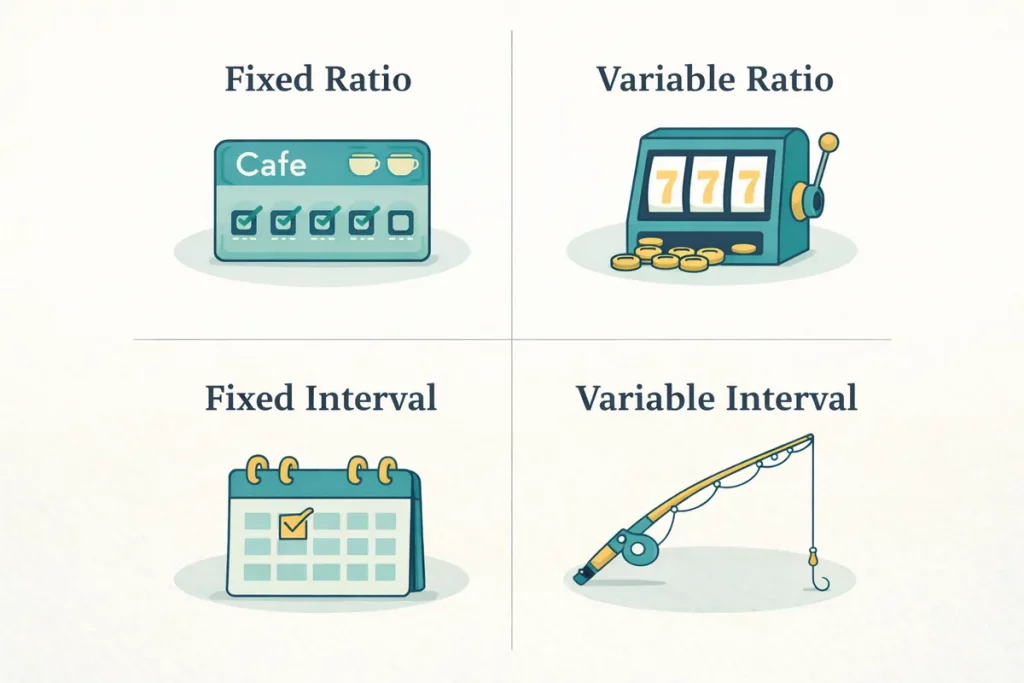
Not all positive reinforcement works the same way; timing matters more than you might think. Psychologists have identified different reinforcement schedules (patterns of when and how often rewards are delivered) that produce distinct effects on behaviour.
Understanding these schedules allows you to optimise your reinforcement strategy based on your goals.
The table below breaks down the key differences in simple terms:
| Schedule Type | How It Works | Real-World Example | Best Used For | Key Advantage | Potential Drawback |
|---|---|---|---|---|---|
| Fixed Ratio | Reward after set number of behaviours (e.g., every 5th) | Coffee shop loyalty card – free drink after 10 purchases | Building new habits; clear goal achievement | Predictable; high motivation near reward | Can lead to post-reward pauses |
| Variable Ratio | Reward after unpredictable number of behaviours (average maintained) | Slot machines; commission-based sales | Maintaining high, consistent performance; preventing extinction | Very resistant to extinction; sustained engagement | Can be frustrating; may feel manipulative if transparent |
| Fixed Interval | Reward after set time period | Monthly salary; weekly allowance | Time-based goals; routine maintenance | Predictable; easy to administer | Performance may dip mid-interval |
| Variable Interval | Reward after unpredictable time periods (average maintained) | Fishing; checking email for important message | Encouraging consistent effort over time | Steady performance; resistant to extinction | Less immediate motivation; harder to plan around |
For building new habits, fixed ratio schedules work well because they provide clear milestones. Once behaviour is established, transitioning to variable schedules creates more sustainable patterns, as the unpredictability maintains engagement longer than predictable rewards.
How Therapists Use Positive Reinforcement in Clinical Settings
Therapists don’t just teach positive reinforcement; they actively use it throughout evidence-based treatments. Understanding how can help you recognise when professional support might enhance your own reinforcement strategies.
Behavioural Activation for Depression: Therapists help clients identify small, achievable behaviours and celebrate accomplishments. The positive feelings that follow reinforce engagement, gradually rebuilding activity levels [3].
Parent-Child Interaction Therapy (PCIT): Therapists coach parents in real-time to notice and immediately praise their child’s positive behaviours whilst strategically ignoring minor misbehaviour. This live reinforcement reshapes parent-child dynamics, reducing conflict and improving behaviour.
These therapeutic applications demonstrate that positive reinforcement isn’t just about external rewards like stickers or treats. It includes recognition, emotional warmth, and noticing progress. It also taps into the natural satisfaction people feel when they grow and master new skills.
At Therapy Central, our qualified and experienced therapists and psychologists regularly use these reinforcement principles within evidence-based approaches like cognitive behavioural therapy (CBT), behavioural activation for depression, and skills-building interventions.

Positive Reinforcement Examples Across Different Life Areas
One of positive reinforcement’s greatest strengths is its versatility. The same fundamental principle applies whether you’re raising a toddler, managing a team, strengthening your marriage, or building personal habits.
Let’s explore concrete examples across key life domains to help you recognise opportunities for effective reinforcement.
Parenting: Building Cooperation and Confidence
Positive reinforcement forms the foundation of effective, relationship-focused parenting.
Rather than relying primarily on criticism or punishment (which can damage self-esteem and create power struggles), reinforcement-based parenting strengthens desirable behaviours whilst maintaining warmth and connection.
Research from the UK’s Department for Education emphasizes that consistent positive reinforcement, combined with clear boundaries, produces better long-term outcomes than punishment-heavy approaches [4]. For detailed age-specific techniques (from toddler sticker charts to teenager autonomy rewards) see the dedicated parenting section below.
Education and Workplace: Motivating Performance and Growth
Positive reinforcement principles translate directly to professional and educational environments, where recognition strategies drive motivation and engagement. UK data from 2024 shows that when recognition happens frequently and meaningfully, employees are eight times more likely to feel a strong sense of belonging [5]. The key is ensuring reinforcement is genuine, specific, and timely; generic corporate praise feels hollow compared to personalized recognition. For detailed workplace and relationship applications, see the dedicated section below.
Personal Development: Building Habits and Self-Discipline
Whilst we often think of reinforcement as something we do for others, self-applied positive reinforcement is a powerful tool for personal growth, habit formation, and behaviour change. This application addresses a significant gap in most psychology content, which focuses almost exclusively on reinforcing others’ behaviour.
Choosing effective self-rewards: The key to successful self-reinforcement is selecting rewards that are:
- Genuinely motivating to you (not what “should” be rewarding)
- Proportionate to the behaviour (small rewards for daily behaviours, larger ones for significant milestones)
- Ideally aligned with your goals (reading an enjoyable book after writing, healthy meal after exercising)
- Not undermining your objectives (rewarding exercise with unhealthy food creates conflicting messages)
Link your rewards to the deeper change you’re aiming for; for example, pairing wins with self-affirmation can reinforce therapy work on low self-esteem.
Practical self-reinforcement strategies:
- Habit stacking with enjoyable activities: “I’ll only listen to my favourite podcast whilst walking” (the enjoyable podcast reinforces the walking behaviour)
- Progress tracking and celebration: Marking off completed workouts on a calendar, then treating yourself to new workout clothes after a month of consistency.
- Social reinforcement: Sharing achievements with supportive friends who’ll respond with encouragement (“I ran 5K today!” followed by congratulatory messages)
- Self-praise and recognition: Consciously acknowledging your efforts (“I handled that difficult conversation with compassion and clarity. I’m proud of how I showed up”)
Transitioning from external to intrinsic motivation: This transition happens gradually, sometimes over months, and that’s completely normal. Some behaviours never become fully intrinsic, and that’s okay. Psychological research on Self-Determination Theory demonstrates that supporting autonomy, competence, and relatedness helps external motivation transform into genuine internal drive [6]. You can facilitate this by choosing habits aligned with your values, noticing natural positive consequences, and gradually reducing external rewards as behaviour becomes established.

Positive Reinforcement in Parenting: Practical Techniques That Work
Given that parenting represents one of the most common applications of positive reinforcement, it’s worth exploring deeper, more nuanced techniques that move beyond basic sticker charts and generic praise.
The UK Department for Education’s 2024 guidance emphasises the role parents play in shaping behaviour. It stresses that parents support schools best when they reinforce behaviour policies clearly and consistently at home [4]. This home-school partnership approach demonstrates how positive reinforcement extends beyond individual parenting moments to create unified support systems for children.
The Power of Descriptive Praise
Most of us grew up hearing “Good job!” and “Well done!”, so that’s what comes naturally when praising our own children. But there’s a more powerful approach that builds deeper understanding and intrinsic motivation. One of the most transformative parenting techniques involves replacing evaluative praise (“Good boy!” “Well done!”) with descriptive praise that specifically names what the child did well.
This approach is more effective because it:
- Teaches children what behaviours to repeat (they understand exactly what pleased you)
- Builds intrinsic motivation (focuses on their actions rather than your approval)
- Develops self-awareness (helps children recognise their own capabilities)
- Avoids praise dependency (reduces reliance on constant external validation)
Examples of descriptive praise:
- Instead of “Good girl for eating your vegetables,” try: “I noticed you tried the broccoli even though you weren’t sure about it. That took courage”
- Instead of “Well done on your homework,” try: “You concentrated for 20 minutes without getting distracted. Your focus is improving”
- Instead of “You’re such a kind child,” try: “You noticed your brother was upset and brought him his toy. That was thoughtful”
This shift helps children develop accurate self-concept and internal standards.
Using Natural and Logical Consequences as Reinforcement
Natural positive consequences often create more sustainable behaviour change than tangible rewards because they demonstrate real-world cause-and-effect. Examples: a child who puts toys away carefully finds them easily next time; a teenager who completes coursework promptly enjoys stress-free evenings.
Logical consequences are arranged by adults but directly relate to the behaviour: a child who feeds the family pet reliably earns the privilege of choosing a new pet toy; a teenager demonstrating responsible phone use receives a later curfew.
Combining consequences with descriptive praise amplifies the reinforcement: “You got your school bag ready last night, and this morning you weren’t rushed at all. How did that feel?” This helps children consciously connect behaviour to positive outcomes.
Building Emotional Regulation Through Reinforcement
An often-overlooked application of positive reinforcement in parenting is reinforcing emotional skills: teaching your child it’s safe to feel frustrated, okay to ask for help, brave to name what’s happening inside. This moves beyond behaviour management to build the emotional foundations that protect mental health throughout life.
Examples of reinforcing emotional regulation:
- “I saw you felt really frustrated when your tower fell down, and you took some deep breaths instead of throwing the blocks. You managed those big feelings so well”
- “You told me you felt nervous about the test instead of keeping it inside. I’m glad you trust me with your worries”
- “When your sister took your crayon, you used your words (‘I was using that’) instead of grabbing it back. That’s excellent problem-solving”
This approach teaches children that expressing emotions appropriately, using coping strategies, and communicating needs verbally are behaviours worth celebrating just as much as completing chores or achieving academically. Over time, this reinforcement builds emotional literacy and self-regulation skills that protect mental health throughout life.
Research from the Anna Freud Centre in London demonstrates that children who receive consistent reinforcement for emotional expression and regulation show lower anxiety levels, better peer relationships, and greater resilience when facing challenges [7].

Using Positive Reinforcement in Relationships and the Workplace
Beyond parenting and self-development, positive reinforcement profoundly shapes our closest relationships and professional environments. Understanding how to apply these principles in adult interactions can transform connection, communication, and collaboration.
Strengthening Romantic Relationships Through Appreciation
Relationship research consistently shows that couples who maintain high ratios of positive to negative interactions enjoy greater satisfaction, stability, and intimacy. Psychologist John Gottman’s research suggests a “magic ratio” of at least 5:1 positive-to-negative interactions in healthy relationships [8].
Positive reinforcement in romantic partnerships works by increasing the frequency of behaviours that strengthen connection.
Examples of relationship reinforcement:
- Expressing appreciation for everyday contributions: “Thank you for picking up groceries on your way home. It saved us time and I really appreciate you thinking ahead”
- Reinforcing emotional availability: “I’m so grateful you listened when I needed to talk about my difficult day. Feeling heard by you means everything”
- Acknowledging effort in conflict resolution: “I noticed you stayed calm and really tried to understand my perspective during that discussion. That made me feel respected even though we disagreed”
- Physical affection following desired behaviour: A warm hug, kiss, or physical touch after your partner does something thoughtful (cooking dinner, initiating a difficult conversation, showing patience with your family)
The key is specificity and genuineness. Generic “I love you” statements are wonderful, but they don’t reinforce particular behaviours. Contrast “You’re great” with “When you texted to check how my presentation went, it showed me you remember what matters to me. That thoughtfulness makes me feel so valued.” The second statement clearly identifies what behaviour to repeat and why it matters.
Workplace Applications: Building Motivated, Engaged Teams
Managers and team leaders who understand positive reinforcement create more productive, innovative, and satisfied teams. The principles remain consistent, but workplace-appropriate application requires professional boundaries and fairness. This matters particularly in the UK, where only 60% of workers report feeling motivated to work above and beyond their roles [5].
Effective manager reinforcement strategies include:
- Immediate specific feedback: Rather than waiting for quarterly reviews, provide real-time recognition: “Your handling of that client call was excellent. You listened without interrupting and proposed a clear solution”
- Public and private praise combinations: Some employees appreciate public recognition; others prefer private acknowledgement. Know your team members’ preferences.
- Matching rewards to values: For some, career development opportunities are more reinforcing than bonuses; for others, financial recognition matters most.
Peer reinforcement: Cultures where colleagues regularly acknowledge each other’s contributions create more positive work environments – team meetings opening with appreciations, peer-nominated recognition, or simple thanks for collaborative support. These practices build psychological safety, which research shows increases both wellbeing and performance [9]. When recognition feels fair, it builds trust; when arbitrary, it breeds resentment.

Common Mistakes to Avoid When Using Positive Reinforcement
Even when we understand positive reinforcement principles theoretically, practical application often reveals subtle errors that reduce effectiveness or create unintended consequences. Recognizing these common mistakes significantly improves your results.
Mistake 1: Delayed Reinforcement
Why it happens: Life gets busy; we intend to acknowledge behaviour but get distracted.
Example: Your child tidies their room Saturday morning but you only mention it Sunday evening. By then, the connection between tidying and your approval is weak.
How to correct: Aim for immediacy – within seconds or minutes, especially when establishing new patterns. If immediate reinforcement isn’t possible, be very specific: “I’m thinking about how you tidied your room yesterday. I was too rushed to tell you then.”
Expected outcome: Stronger behaviour-reward associations lead to faster learning.
Mistake 2: Inconsistent Application
Why it happens: We reinforce behaviour based on our mood rather than the behaviour itself.
Example: Sometimes you enthusiastically praise your partner for initiating difficult conversations; other times you respond dismissively. This inconsistency makes them uncertain whether vulnerability is welcome.
How to correct: When building new behaviours, aim for consistent reinforcement every time. If overwhelmed, a simple “I notice and appreciate what you just did” maintains the pattern.
Expected outcome: Predictability helps people feel safe repeating behaviours.
Mistake 3: Using Rewards That Aren’t Valued
Why it happens: We assume we know what others find rewarding without asking.
Example: A manager implements public “Employee of the Month” recognition, but introverted team members find public attention embarrassing. The “reward” actually functions as mild punishment.
How to correct: Personalize reinforcers. Ask: “What would feel like meaningful recognition to you?” One child loves stickers; another prefers extra playtime. Public praise thrills some and embarrasses others.
Expected outcome: Rewards that genuinely appeal produce stronger, more sustained behaviour change.
Mistake 4: Creating Reward Dependency
Why it happens: We maintain constant reinforcement indefinitely, worrying behaviour will disappear without it.
Example: A child now asks “Do I get a sticker?” before starting homework. Without stickers, homework doesn’t happen – the child performs for rewards rather than developing intrinsic interest.
How to correct: Plan for gradual fading of external rewards. Start with continuous reinforcement, then move to intermittent schedules, finally shifting to natural consequences and intrinsic satisfaction.
Expected outcome: Behaviours become internally motivated rather than dependent on continuous external rewards.
Mistake 5: Reinforcing the Wrong Aspect or Slipping Into “Punishment Creep”
Why it happens: We focus on outcomes rather than effort, or we undermine reinforcement by adding criticism.
Example scenario: Your teenager brings home a test result. You say, “Well done on getting 75%… but you could have scored higher if you’d revised more.” The initial praise (reinforcement) is immediately cancelled by the criticism, creating a “praise sandwich” that feels insincere and deflating.
How to correct: When reinforcing, focus purely on the positive without qualifications or “but” statements. Save constructive feedback for separate conversations. Reinforce effort, persistence, and process as much as outcomes; this builds growth mindset and resilience.
Expected outcome: People feel genuinely appreciated and learn to value their efforts, creating sustainable motivation and stronger relationships.
Applying positive reinforcement effectively requires thought, consistency, and genuine attention to what motivates the people around you. When done well, it transforms behaviour change from a struggle into a collaborative, rewarding process that strengthens relationships and builds intrinsic motivation.

If implementing these strategies feels overwhelming or you’re facing persistent challenges with behaviour patterns – whether in parenting, relationships, or personal habits – we offer flexible scheduling from early morning to late evening, including weekends, with both online sessions and London appointments available. Book a free consultation to explore how our qualified and experienced therapists and psychologists can help you develop tailored reinforcement approaches for your unique situation.
FAQ
What is positive reinforcement in simple terms?
Positive reinforcement means rewarding a behaviour you want to see more of, making it more likely to happen again. For example, praising your child when they share toys encourages sharing in future. The reward strengthens the behaviour.
What are three examples of positive reinforcement?
(1) A parent praising their child for completing homework; (2) A manager thanking an employee for meeting a deadline; (3) Treating yourself to something enjoyable after exercising. Each reward encourages repeating the positive behaviour.
How is positive reinforcement different from negative reinforcement?
Positive reinforcement adds something pleasant (like praise) to encourage behaviour. Negative reinforcement removes something unpleasant (like nagging stops when chores are done) to encourage behaviour. Both increase desired behaviours, but positive reinforcement tends to create more positive emotional associations.
Does positive reinforcement work for adults?
Absolutely. Adults respond to positive reinforcement in relationships (appreciation strengthens connection), workplaces (recognition boosts performance), and self-development (rewarding progress builds habits). The principle applies across all ages, though rewards differ based on individual preferences.
Can you overuse positive reinforcement?
Yes. Over-reliance can lead to reward dependency, where behaviour only occurs when rewards are guaranteed. Gradually reduce external rewards as behaviours become intrinsically motivated, transitioning from frequent to intermittent reinforcement.
What are common mistakes when using positive reinforcement?
Common mistakes include delaying rewards (reducing effectiveness), providing inconsistent reinforcement (confusing the learner), using rewards that aren’t actually valued, and failing to pair tangible rewards with social praise. Timing and consistency matter most.