Do you find yourself constantly googling symptoms, convinced that every headache signals something serious? You’re not alone. Health anxiety affects millions of people worldwide, and in the UK, anxiety disorders affect 5.6% of the population.
While there’s no magic “cure,” effective treatments can help you break free from this exhausting pattern and get back to living without constantly checking your body for problems.
If you’re struggling with health anxiety, Therapy Central’s health anxiety specialists understand exactly what you’re going through and can provide the targeted support you need.
How can I stop health anxiety?
Health anxiety usually improves through Cognitive Behavioural Therapy (CBT), mindfulness, and reducing reassurance-seeking or symptom-checking behaviours. These approaches help you challenge catastrophic thoughts, tolerate uncertainty, and respond more calmly to bodily sensations. Many people begin to see progress within 12 to 16 weeks of consistent therapy.
Understanding Health Anxiety
If you’re reading this, you probably know that feeling: when every little ache or pain sends your mind racing. Health anxiety (what doctors call illness anxiety disorder) is more than just occasional worry about your wellbeing. It’s a persistent, overwhelming fear that you have or will develop a serious medical condition, despite having few or no symptoms.

Think about it like this: your mind becomes an overly sensitive smoke alarm that can’t tell the difference between steam from your morning shower and actual smoke from a fire. Every minor bodily sensation triggers the alarm, sending you into a spiral of worry and checking behaviours.
What Health Anxiety Looks Like
If you’re experiencing health anxiety, you might recognise these patterns:
- Constant body scanning – You’re hyper-aware of every sensation, ache, or change
- Endless medical research – Hours spent googling symptoms and reading medical websites
- Reassurance seeking – Repeatedly asking friends, family, or doctors for confirmation that you’re okay
- Avoidance behaviours – Staying away from medical shows, news, or situations that might trigger anxiety
- Physical symptoms – The anxiety itself can cause real symptoms like racing heart, sweating, or stomach issues
The Cycle That Keeps You Stuck
You’ve probably noticed this exhausting pattern: you feel something in your body, immediately think “what if it’s serious?”, Google frantically for answers, feel briefly better when you find reassurance, then start the whole process again with the next sensation. Each time you engage in checking or reassurance-seeking, you’re strengthening the anxiety rather than reducing it.
At this stage, we need to understand the difference between normal health awareness and problematic health anxiety. We all need to pay attention to our bodies, but health anxiety crosses the line when worry becomes overwhelming and interferes with daily life. Here’s how health anxiety differs from regular health consciousness:
| Normal Health Awareness | Health Anxiety |
|---|---|
| Occasional concern about symptoms | Persistent, overwhelming worry |
| Reasonable medical check-ups | Frequent, excessive doctor visits |
| Logical health precautions | Avoidance of normal activities |
| Reassurance provides lasting comfort | Reassurance offers only brief relief |
| Able to tolerate some uncertainty | Cannot tolerate any health uncertainty |
| Focus on overall wellbeing | Obsessive focus on potential illness |
Why “Curing” Health Anxiety is Complex
We often hear people searching for how to “cure” health anxiety, and it’s understandable why. When you’re trapped in constant worry, you want it gone forever. However, thinking about recovery in terms of a “cure” can work against you.
A More Helpful Way to Think About Recovery
Rather than aiming to eliminate all health-related thoughts, recovery focuses on changing your relationship with these thoughts. It’s about learning to:
- Recognise anxiety thoughts without believing them
- Tolerate uncertainty about your health
- Respond to bodily sensations with curiosity rather than panic
- Build confidence in your ability to cope with whatever comes your way
Why Quick Fixes Don’t Work
Health anxiety often develops over months or years, shaped by experiences, personality traits, and sometimes family patterns. Research shows that sustainable recovery requires addressing both the thought patterns and behaviours that maintain the anxiety, rather than seeking temporary relief. The most effective approaches help you build skills that serve you long-term, creating resilience rather than dependence on reassurance.
Health Anxiety Treatment: Evidence-Based Approaches
Here’s the good news: health anxiety responds very well to treatment. Research consistently shows that several approaches can reduce symptoms and improve quality of life, with many people experiencing substantial improvement within weeks of starting treatment.

Cognitive Behavioural Therapy (CBT)
CBT is considered the gold standard for treating health anxiety, with extensive research supporting its effectiveness. A comprehensive meta-analysis found that CBT leads to large reductions in health anxiety and maintains these benefits at longer-term follow-up 1. This approach helps you understand and change the patterns that keep you stuck.
You’ll learn to identify unhelpful thinking patterns that probably feel very familiar:
- Catastrophising (“This headache must be a brain tumour”)
- All-or-nothing thinking (“If I’m not 100% healthy, something’s terribly wrong”)
- Probability overestimation (believing rare conditions are likely)
Then you’ll practise challenging these thoughts by examining the evidence and developing more balanced perspectives. It’s not about pretending your concerns don’t matter – it’s about learning to evaluate them more objectively.
Finally, you’ll gradually change the behaviours that maintain the anxiety, like excessive checking or googling. This part can feel scary at first, but you’ll do it at your own pace with plenty of support.
Health Anxiety CBT Techniques
In CBT, we’ll work together on practical tools you can use right away. You might start keeping a thought diary – not because we think you’re being irrational, but because seeing your worries on paper often reveals patterns you hadn’t noticed.
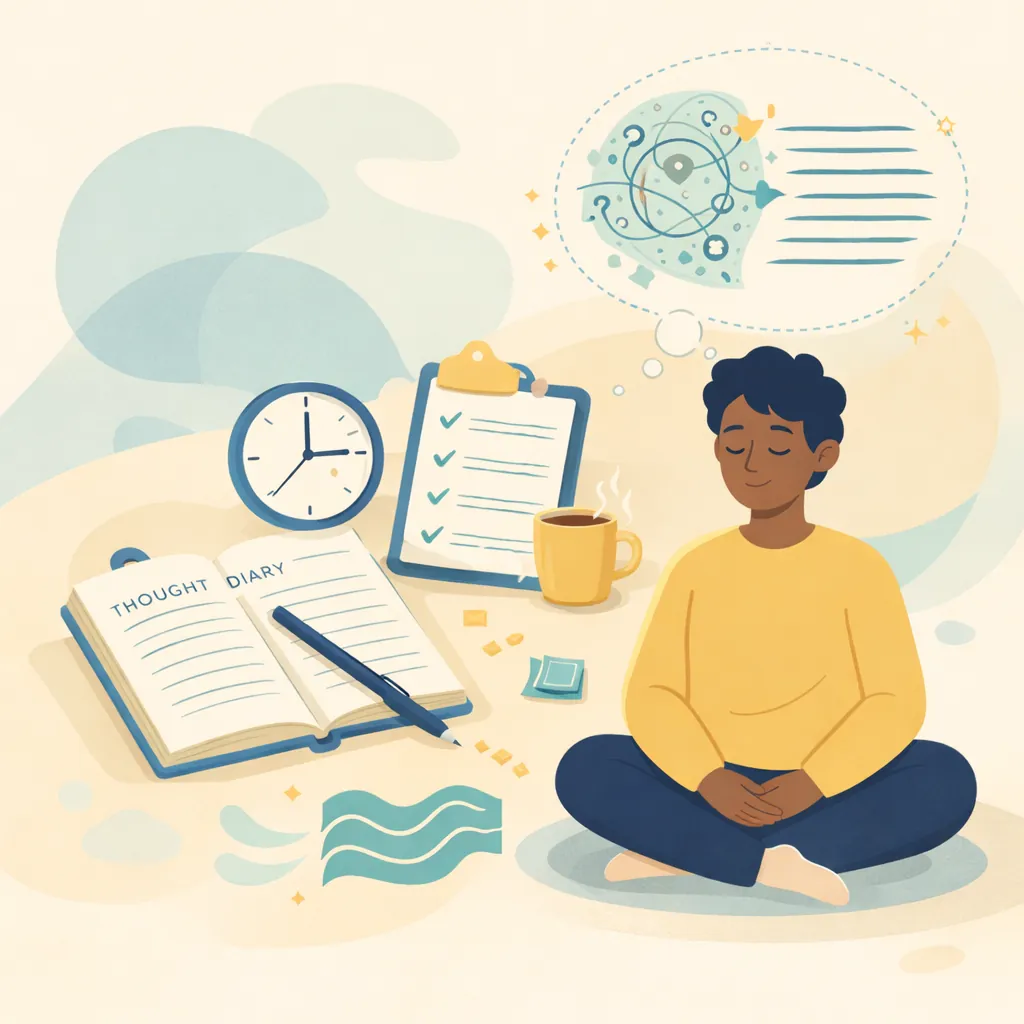
Beyond thought diaries, there are other practical approaches that many people find helpful:
- Behavioural experiments – Testing out your fears in safe, controlled ways
- Attention training – Learning to focus outward rather than constantly inward
- Worry time – Scheduling specific periods for health concerns rather than worrying all day
- Response prevention – Gradually reducing checking and reassurance-seeking behaviours
The beauty of CBT is that it provides you with concrete tools you can use independently. Rather than relying on others for reassurance, you develop your own internal resources for managing anxiety.
Exposure and Response Prevention
This might sound scary, but it’s about gradually facing your fears in a controlled way. Think of it like getting comfortable in a swimming pool – you might start by just putting your toes in the shallow end, then gradually work your way to deeper water as you build confidence.
For health anxiety, this might involve:
- Reading health information without immediately seeking reassurance
- Noticing bodily sensations without checking or googling
- Reducing the frequency of doctor visits or body checking
- Watching medical programmes you’ve been avoiding
- Tolerating uncertainty about minor symptoms
The key is that exposure work is always done gradually and with support, building confidence step by step.
Mindfulness and Acceptance Approaches
Mindfulness techniques help you observe your thoughts and sensations without getting caught up in them. You learn to notice anxiety as a temporary experience rather than something that demands immediate action.
Key mindfulness practices include:
- Body awareness exercises that increase comfort with normal sensations
- Breathing techniques for managing acute anxiety
- Acceptance of uncertainty as a normal part of life
- Present-moment awareness to reduce anticipatory worry
Therapy for Health Anxiety: What Professional Support Looks Like
Understanding what happens in therapy can help reduce anxiety about starting treatment and give you realistic expectations about the process. NHS guidelines recommend 12-15 weekly CBT sessions for anxiety disorders, with each session lasting about an hour 2.
Initial Assessment and Understanding
Your therapist will want to understand:
- When your health anxiety started and what might have triggered it
- What triggers it most in your current life
- How it impacts your daily activities and relationships
- What you’ve tried before and how it worked
- Your specific goals for treatment
This assessment helps create a personalised treatment plan that addresses your unique situation and concerns.
Building Your Toolkit
Therapy isn’t just about talking; you’ll actively learn and practise skills. Your therapist might introduce:
- Techniques for managing acute anxiety episodes
- Ways to challenge unhelpful thoughts objectively
- Strategies for reducing checking behaviours
- Methods for tolerating uncertainty
- Communication skills for discussing health concerns appropriately
Gradual Exposure Work
As you feel ready, you’ll work together on gradually facing situations that trigger health anxiety. This always happens at a pace you can manage, building confidence step by step.
Your therapist will help you:
- Identify specific fears and avoidance behaviours
- Create a hierarchy of challenges from least to most anxiety-provoking
- Practise new responses to anxiety-triggering situations
- Build tolerance for the discomfort that comes with change
Homework and Practice
Like learning any new skill, overcoming health anxiety requires practice outside of sessions. This might include:
- Keeping thought records to identify patterns
- Practising mindfulness exercises daily
- Completing behavioural experiments
- Reducing specific checking behaviours gradually
- Implementing new coping strategies in real-life situations
Hypochondria Treatment: Modern Understanding and Approaches
The term “hypochondria” has been largely replaced by “health anxiety” or “illness anxiety disorder” in modern psychology. This shift reflects a better understanding that this isn’t about being “difficult” or “attention-seeking” – it’s a genuine anxiety condition that deserves compassionate, effective treatment.
About 75% of people previously diagnosed with hypochondria now meet criteria for Somatic Symptom Disorder, while the remaining 25% are classified under Illness Anxiety Disorder 3. This reclassification helps healthcare providers offer more targeted treatment approaches.
What We Know Now
Research has shown that health anxiety often develops from:
- Past medical experiences – Your own or witnessing others’ health scares
- Family patterns – Growing up in a family that was very focused on health concerns
- Personality traits – Higher sensitivity or tendency toward anxiety
- Life stress – Major life changes can trigger health anxiety in vulnerable individuals
- Information processing – Tendency to interpret ambiguous information as threatening
Modern Treatment Approaches
Modern hypochondria treatment focuses on:
- Understanding your unique triggers and patterns
- Building tolerance for bodily sensations and medical uncertainty
- Developing healthy ways to care for your physical health without obsessing
- Creating a balanced relationship with medical information and healthcare
- Learning to distinguish between appropriate health monitoring and excessive worry
The goal isn’t to eliminate all health awareness, but to develop a balanced, realistic approach to physical wellbeing.
Can Health Anxiety Cause Fake Symptoms?
If you’ve ever wondered whether you’re “making up” your symptoms, let’s clear this up right away: what you’re feeling is real. The symptoms you experience are genuine; they’re just caused by anxiety rather than physical illness.
How Anxiety Creates Physical Symptoms
When you’re anxious, your body activates its stress response system 4. This can cause very real symptoms including:
- Racing or irregular heartbeat
- Muscle tension and aches
- Dizziness or lightheadedness
- Sweating and trembling
- Digestive issues
- Breathing difficulties
- Headaches and fatigue
Chronic anxiety can also have longer-term health impacts, potentially impairing immune system function and increasing the risk of cardiovascular disease 5.
The Mind-Body Connection
Your brain and body are intimately connected. When your mind perceives threat (even when there isn’t one), your body responds as if the danger is real. This isn’t “all in your head” – it’s how human beings are designed to work.
Understanding this connection often brings real comfort to people. It helps explain why:
- Physical symptoms feel so real and concerning
- Anxiety can create a wide variety of symptoms
- Symptoms often change or move around the body
- Reassurance provides only temporary relief
Breaking the Symptom-Anxiety Cycle
When you know that anxiety can create symptoms, you can:
- Respond to symptoms with less panic
- Use anxiety management techniques to reduce physical symptoms
- Build confidence that you can cope with whatever you’re experiencing
- Develop a more balanced relationship with bodily sensations
Taking the First Step: Getting Help for Health Anxiety
If health anxiety is affecting your quality of life, you don’t have to struggle alone. Professional help can make a significant difference, and seeking support is a sign of strength, not weakness.
When to Seek Help
Consider reaching out if:
- Health worries dominate your thoughts most days
- You’re avoiding activities because of health fears
- You’re checking your body or seeking reassurance multiple times daily
- Health anxiety is affecting your relationships or work
- You feel hopeless or exhausted by constant worry
- You’re spending excessive time researching symptoms online
What Makes Therapy Central Different
At Therapy Central, we understand that health anxiety isn’t just about anxious thoughts; it’s about feeling safe in your own body again. Our approach combines:
Evidence-based treatments tailored to your specific needs and goals, including the latest CBT techniques designed for health anxiety.
Compassionate understanding of how isolating and exhausting health anxiety can be, without judgement about your fears or concerns.
Practical skills you can use immediately to start feeling more in control, even before your anxiety fully resolves.
Flexible support with both online therapy and in-person sessions in London available, making treatment accessible regardless of your circumstances.
Many of our therapists are trained in the latest approaches to anxiety treatment, including CBT, mindfulness-based therapies, and exposure techniques designed for health anxiety. We understand that each person’s experience is unique, and we tailor our approach accordingly.
Your Path to Recovery
While everyone’s journey is different, most people notice improvements within a few weeks of starting treatment, with significant progress over 12-16 weeks.
You might find that:
- Anxious thoughts become less frequent and intense
- You’re able to notice bodily sensations without panic
- You spend less time googling or seeking reassurance
- You feel more confident in your ability to cope with uncertainty
- Your relationships improve as anxiety takes up less mental space
- You can engage in activities you’ve been avoiding
Taking Action Today
Don’t let health anxiety continue to control your life. What would it feel like to stop googling symptoms and start trusting your body again? Contact us for a free 15-minute consultation to discuss how we can help you break free from the cycle of worry and reclaim your peace of mind.

Our team is here to support you every step of the way, providing the tools and understanding you need to build a healthier relationship with your body and mind. We’ve helped many people overcome health anxiety, and we’re confident we can help you too.
FAQ
What therapy is good for health anxiety?
Cognitive Behavioural Therapy (CBT) is the gold standard treatment with extensive research support. CBT helps change negative thought patterns and reduce anxiety-driven behaviours like excessive symptom checking and reassurance seeking.
Is health anxiety disorder curable?
While there’s no single “cure,” health anxiety is highly treatable with success rates of 50-62% recovery. Evidence-based therapies like CBT help most people manage symptoms effectively and improve quality of life significantly long-term.
How to stop intrusive thoughts in health anxiety?
Mindfulness techniques, thought challenging exercises, and CBT help manage intrusive thoughts effectively. Learning to observe thoughts without believing them reduces their power and frequency over time with consistent practice.
Can health anxiety cause real physical symptoms?
Yes, anxiety activates your body’s stress response, creating real symptoms like racing heart, muscle tension, dizziness, and digestive issues. These symptoms are genuine but caused by anxiety rather than serious illness.
How long does it take to recover from health anxiety?
Most people see improvements within 4-6 weeks of starting CBT, with significant progress over 12-16 weeks. Recovery is gradual, and everyone progresses at their own pace depending on individual circumstances.