Deciding to start therapy is one of the bravest steps you’ll take for your mental wellbeing. But what actually happens once you’re sitting in that room (or logging onto that video call)?
You might be feeling a mix of curiosity, anticipation, and also maybe some nerves, which is completely normal. We’ve created this guide to walk you through the entire journey, including before, during, and after your first therapy session. This way you can step into this new chapter feeling informed and empowered.
Understanding how therapy works begins with a first appointment, where you’ll start building the foundation for your therapeutic journey.
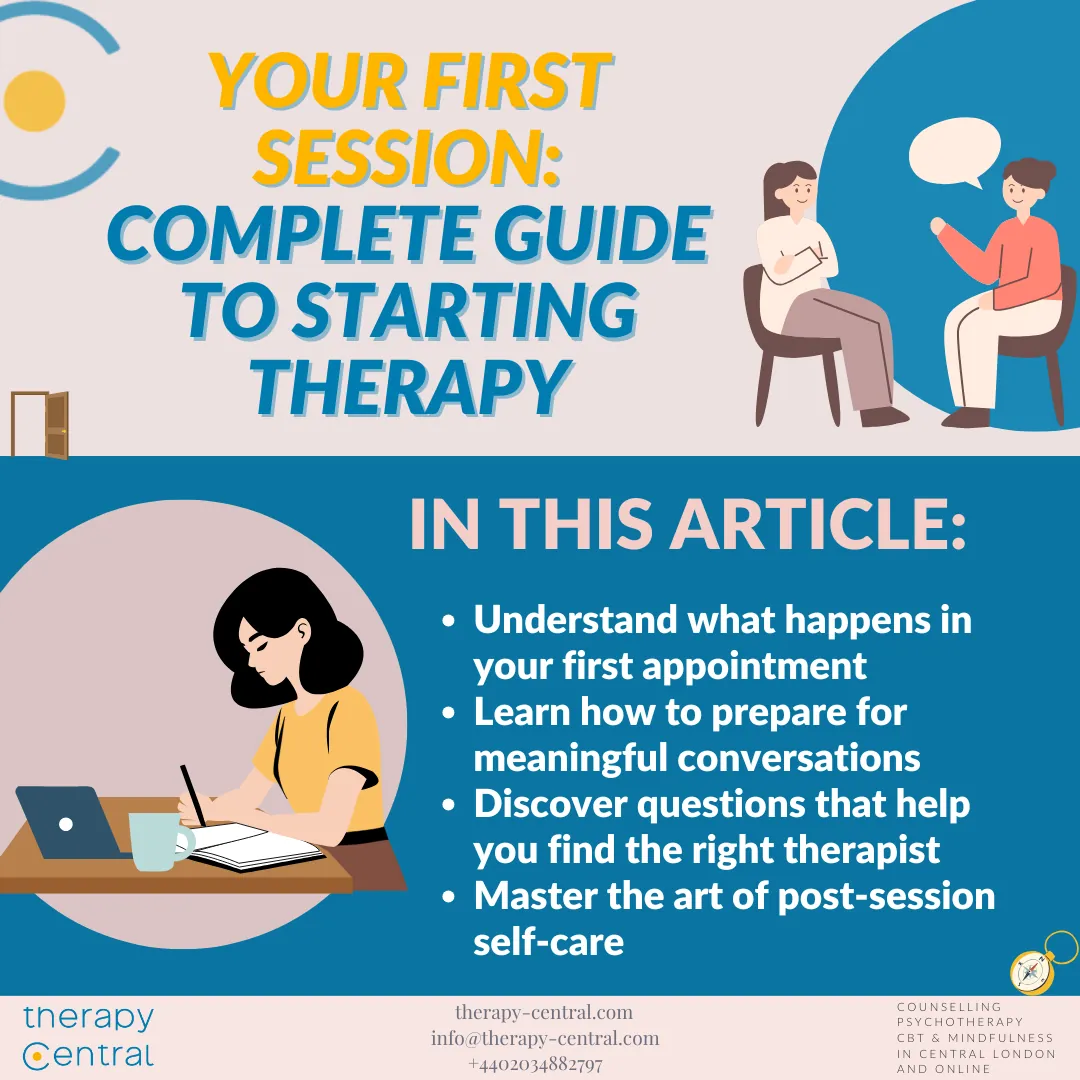
Here’s what to expect in your first therapy session, in a nutshell:
- Getting to know each other: A conversation, not an interrogation.
- Discussing confidentiality and logistics: Setting the ground rules for a safe space.
- Sharing your story: You are in control of what you share.
- Asking questions: It’s a two-way street.
- Setting goals: A collaborative process to define what you want to achieve.
First sessions in therapy often follow a similar shape, but keep in mind that the details can vary depending on the therapist, therapeutic approach, service setting, and your needs.
Before Your Session: Preparing for Your First Therapy Session
Proper preparation can transform your initial therapy session from daunting to empowering. Think of this phase as one that helps you set yourself up for success rather than cramming for an exam.

What to Feel: Your Emotional Journey
It’s completely normal to feel confused, scared, excited and overall a mix of feelings before your first session, especially if it’s the first time you approach therapy or counselling. Some of the most common emotions you might be feeling at this stage are:
- Anxiety or nervousness: “What if I don’t know what to say?” or “What if they think I’m beyond help?”
- Hope mixed with scepticism: “I really want this to work, but what if it doesn’t?”
- Vulnerability concerns: “I’ve never opened up to a stranger like this before.”
- Relief: “Finally, I’m doing something about this.”
- Uncertainty: “Am I ready for this? Is this the right time?”
These feelings aren’t just normal, they’re actually quite helpful. They show you’re taking this seriously and that you care about the outcome. Your therapist has likely seen many different emotional states in first sessions, so there’s really quite nothing you could say or feel that would surprise them.
Practical Preparation Checklist
One week before:
- Reflect on what brought you to seek therapy (a feeling, an issue, a situation, a relationship, and so on..)
- Jot down your main concerns or goals (no need for a formal list)
- Consider what you hope to achieve in the short and long term (make this as concrete as possible!)
- Prepare any questions you have about the process
Day before:
- Ensure you have the correct appointment details
- Plan your route (for in-person), including how long it will take you to get there, so you don’t risk arriving late; or test your technology (for online)
- Do something relaxing to manage pre-session nerves
- Remind yourself: this is a positive step you’re taking
Day of session:
- Arrive or connect 5-10 minutes early (or log in with time to spare)
- Make sure you have water and tissues if needed
- Wear comfortable clothing if possible
- Turn off notifications on your phone

Questions to Ask a Therapist
Preparing thoughtful questions helps you make the most of your initial therapy session and determine if this therapist is the right fit for you.
Here are some key questions you might want to consider asking, along with why they matter:
| Question | Why It Matters |
|---|---|
| What is your experience working with people who have similar concerns to mine? | Helps you understand if the therapist has relevant expertise for your specific needs |
| What does a typical session with you look like? | Helps you get a sense of their approach and what to expect moving forward |
| How will we know we’re progressing? | Can help you set clear expectations for tracking your improvement, but this can vary depending on the approach your therapist uses, and on whether you’ve established a clear goal (or goals) |
| How do you handle confidentiality, and what are the exceptions? | Ensures you understand the privacy boundaries |
| What happens if I don’t feel like we’re a good match? | Shows their professionalism and your options |
Additional questions based on your situation:
- “What therapy approaches do you normally use?”
- “How often do you meet with clients?”
- “What should I do if I have a crisis or need support between sessions?”
Common Myths vs Reality
Before your first session, let’s clear up some misconceptions that might be creating unnecessary anxiety.
| Myth | Reality |
|---|---|
| “Therapy is only for people with serious mental illness” | Therapy helps anyone wanting to improve their mental wellbeing, develop coping skills, or navigate life challenges |
| “I’ll have to lie on a couch and talk about my childhood” | Most therapy happens in comfortable chairs with normal conversation, focusing on whatever you want to discuss |
| “The therapist will judge me or think I’m weak” | Therapists are trained to provide non-judgmental support and see seeking help as a sign of strength |
| “I have to share everything in the first session” | You control what you share and can take as much time as you need to open up |
| “Therapy will take years to work” | Many people see improvements within weeks or months, though everyone’s timeline is different, and it depends on the issue and approach used |
| “If I start crying, I’ll never stop” | Emotional releases in therapy are healthy and normal. Most therapists are skilled at helping you through them, and use them to your advantage |
| “I should have my life figured out before starting” | Therapy is specifically for when you don’t have things figured out, that’s the whole point, isn’t it? |
During Your Session: What to Expect in Your First Therapy Session
Your first therapy session is fundamentally about connection and understanding. You can think of it as the beginning of a collaborative relationship rather than a medical examination. You’re the expert on the matter (you and whatever’s going on your life you’d like help with), and the therapist knows more about the ‘method’ (how to help you reach your goals, whatever your circumstances are, and depending on the therapist’s approach).
The Initial Conversation: Sharing Your Story
Your therapist will likely start by asking an open-ended question like “What brings you here today?”, “What’s been on your mind lately?”, or a very simple “How can I help?”. None of these are meant to be seen as a test. Remember, the space is yours, so there’s really no right or wrong answer here.
You might start with something like:
- What’s feeling most urgent or pressing right now
- A recent situation that made you to seek therapy
- A general overview of ongoing challenges
- Whatever feels most comfortable to share first
What the therapist is during this time:
- Listening without judgment: Therapists are trained to create a safe, non-judgmental space where you can speak freely; their focus is on understanding what’s going on for you and what it’s like for you to experience that.
- Understanding your perspective: Therapists won’t try to “fix” you immediately. They’re learning about how you see and experience your world.
- Identifying patterns: Your therapist might gently explore themes or patterns, but this isn’t about making you feel analysed, more about finding links in order to start to figure out why things work the way they do, and later find a way forward.
- You are in control: You only need to share what you feel comfortable with, and you can always say “I’m not ready to talk about that yet.” That’s completely fine. Being honest and direct is a massive asset in therapy. Use it.
- It’s a safe space: Everything you say is confidential, although there are some legal and ethical limits; for example, if there is a risk of serious harm to you or others 1.

Setting the Stage: The Therapy Consultation Process
During this initial therapy session, your therapist will also cover important practical matters. This isn’t bureaucracy, but more about creating a framework that keeps the work together predictable, effective and safe.
Confidentiality discussion:
- Your therapist will explain what confidentiality means in practice
- Clarify the (quite) rare exceptions (risk of harm to yourself or others)
- Discuss how we handle notes and records
- Address any concerns you have about privacy
Session structure and logistics:
- Frequency: Most clients benefit from weekly sessions, though this can be adjusted based on your needs and circumstances. This also varies depending on the therapist, the approach and your needs. Feel free to ask more about this if you’re unclear.
- Duration: Most sessions typically last 50 minutes, but occasionally session length can vary.
- Format: Depending on the therapist or service, sessions may be online or in person. You’ll settle on one or the other before your sessions start.
Our therapeutic approach: Your therapist may briefly explain the approach they use, such as Cognitive Behavioural Therapy (CBT), psychodynamic therapy, mindfulness-based work, or other evidence-based methods, and why it may be a good fit for your needs. You’re always welcome to ask questions about your therapist’s approach. Again, it’s your space and you shouldn’t feel afraid to ask any questions about the work you’re doing with your therapist.
Professional standards: Your therapist should explain confidentiality, note-keeping, and the professional standards they work within. Depending on their training and registration, this may include supervision, consultation, or other forms of reflective practice. If you are unsure, it is completely reasonable to ask how they work and which professional standards apply to them. 2.
The Collaborative Goal-Setting Process
Towards the end of your first session, it’s common to begin exploring what you’d like to achieve through therapy. This isn’t about creating a rigid plan, but more about understanding your hopes and direction. The more concrete your goals are (think like things you could see in your life), the clearer the path towards them can become.
Questions you might explore together with your therapist:
- What would life look like if therapy is successful for you?
- Are there specific situations you’d like to handle differently?
- What coping skills would be most helpful to develop?
- How will you know when you’re making progress?
Your homework (if you want it): Some people find it helpful to have something to think about or work on between sessions. This might be as simple as noticing certain patterns or as structured as keeping a brief mood diary. Your therapist may suggest something like this if you’re interested. Therapy isn’t school, and there are no marks for participation. Whether your therapist will suggest some work in between sessions will also depend on their orientation, for instance, this is more likely with CBT therapists than with psychodynamic ones. Regardless of the therapist’s approach, if you’re interested in working on things in between sessions, feel free to ask.
The Therapeutic Relationship: Building Connection and Trust
The relationship between you and your therapist is one of the most, if not the most, important factor in successful therapy. Research consistently shows that this connection, what is also called the therapeutic alliance, predicts positive outcomes more than any specific technique or approach.
Building Trust: What This Looks Like in Practice
Trust in therapy isn’t about feeling instantly comfortable sharing your deepest secrets the moment you meet with your therapist for the first time. It will develop gradually, session by session, through consistent, reliable and honest interactions.
Signs you’re building a good therapeutic relationship:
- You feel heard and understood, even when discussing difficult topics
- Your therapist tends to remember important details from previous sessions
- You feel comfortable expressing disagreement or confusion (though this could be an arrival point or a goal if you lack assertiveness in particular)
- There’s a sense of working together, collaborating, rather than being “treated” or “fixed”
- You leave sessions feeling validated, even if you don’t feel immediately better. Though this doesn’t mean feeling ‘better’ after every session.
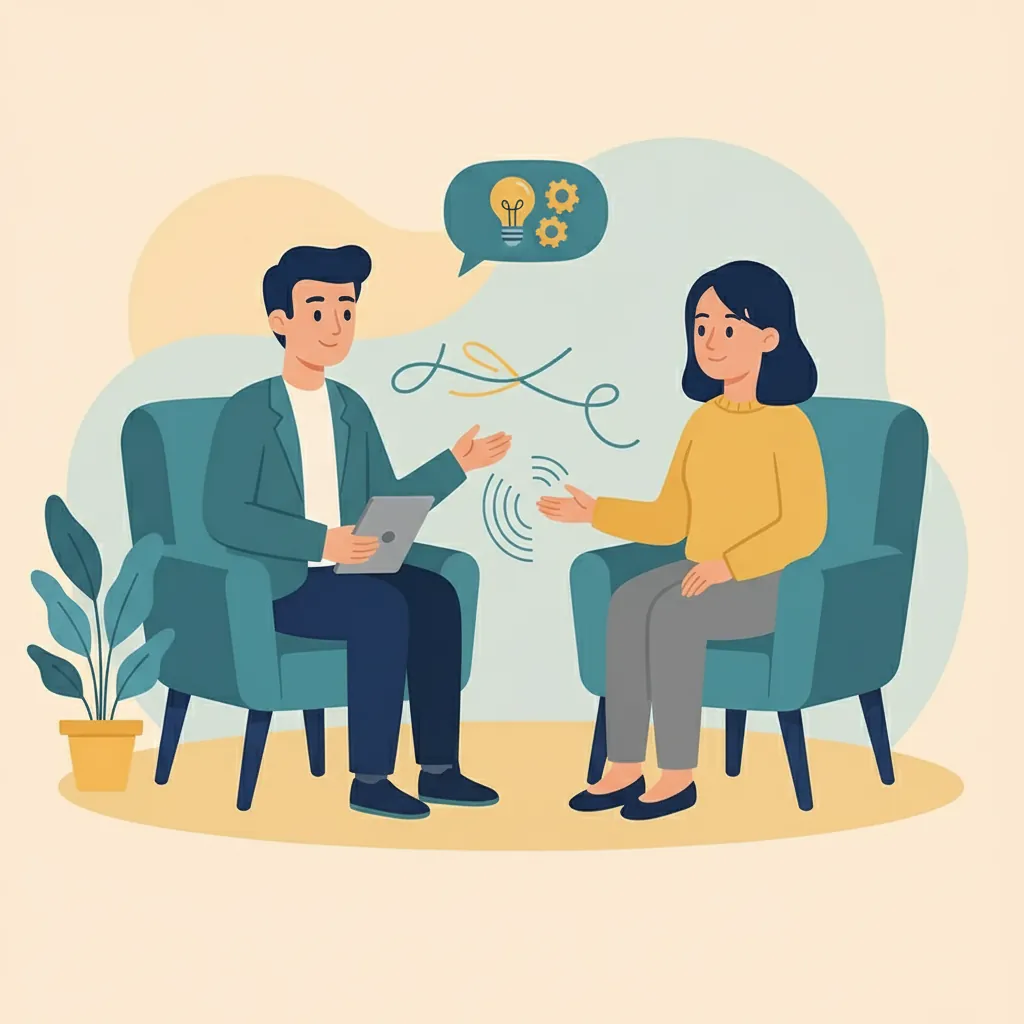
If something doesn’t feel right: Not every client-therapist pairing is created equal, and that’s completely normal, because the fit with your therapist isn’t that different from that you might feel with someone else you’ve just met. Despite that, good therapists will check in regularly about how you’re feeling in the relationship and will always welcome feedback.
Red flags to watch for:
- Feeling judged or criticised
- Your therapist consistently running late or seeming distracted
- Personal sharing from the therapist that feels inappropriate
- Feeling rushed or not heard
- Any boundary violations
The Therapy Central promise: ‘clicking’ with your therapist is very important to build a strong and effective therapeutic alliance. This is why, if after the first session you feel the match isn’t right, we’ll offer you to try it with another therapist, free of charge. If the fit isn’t right, the first session with a new therapist is on us.
Moving Forward: Deciding About Continued Sessions
By the end of your first session, you’ll get a sense of whether you’d like to continue with that therapist. Some people decide quickly, whereas others find it helpful to have a second session before making up their mind.
What to consider at this stage:
- Do you feel comfortable with their communication style?
- Do they seem knowledgeable about your particular concerns?
- Did you feel heard and validated during the session?
- Are their practical arrangements (timing, location, fees) workable for you?
- Do you feel hopeful about the potential for progress?
- Do you feel like you’re willing to work together on your difficulties?
Keep in mind that finding the right therapeutic match may take a few tries, and even a few sessions to understand if the fit is right. The way you might feel after session one, may be very different from session two or three, and that’s perfectly acceptable. It may be helpful to give it time. Regardless, whether you choose to stick with your therapist after the first session or want to try a new one, what matters most is that you don’t give up on the process to find a therapeutic relationship that feels safe, containing and where you can be honest and open.
After Your Session: Processing and Self-Care
The conversation doesn’t end when you leave the therapy room. How you process and care for yourself after your first session can have a big impact on what happens next in your overall therapeutic journey.
What you might feel after the first session
It’s completely normal to experience a variety of emotions after your initial therapy session. You might feel relieved, energised, exhausted, frustrated, upset, or even overwhelmed 2. Sometimes you’ll feel several of these at once, or they might shift throughout the day. This is even more likely if you’re not used to opening up to someone, especially somebody new, about your feelings, which is not uncommon for those seeking therapy for the first time.
Common post-session experiences:
Emotional release: You might find yourself feeling tearful or emotionally raw. This isn’t a sign that something went wrong, on the contrary, it often indicates that you’ve started to process feelings that have been building up. Great sign.
Mental fatigue: Therapy is mental work. Feeling tired after opening up and focusing intensely for an hour is completely normal, especially if you’re not used to doing that with another person.
Increased awareness: You might notice thoughts, feelings, or patterns that weren’t on your radar before the session.
Vulnerability hangover: Some people feel exposed or wonder if they shared too much. This usually settles as you become more comfortable with the process. Again, completely normal, especially if you’re not used to sharing personal stuff with others, which is something that by definition, makes us vulnerable.
Hope and motivation: Many people leave their first session feeling optimistic about the possibilities ahead. This is a great place to be, leverage it!
Your Post-Session Toolkit: Practical Self-Care Strategies
Immediate after-care (first few hours):
- Hydrate: Seriously, it’s not just about your mind. Emotional processing is physically demanding
- Move gently: A short walk or gentle stretching can help integrate the experience
- Avoid major decisions: Give yourself time to process before making significant choices
- Be patient with yourself: You might feel more sensitive than usual, and that’s okay. Pace yourself and treat yourself with kindness.
Reflection practices:
- Jot down your thoughts: Write freely about anything that came up during or after the session. You might decide to share what you’ve found with your therapist at session two.
- Notice what surprised you: What was different from your expectations?
- Identify what resonated: Which moments or insights felt particularly meaningful? Useful?
- Note any questions: What would you like to explore further next time? What you forgot to ask? What you decided not to say, and why?
Ongoing self-care:
- Maintain routines: Stick to regular sleep, meals, and activities that ground you, including physical activity and exercise
- Connect with support: Reach out to trusted friends or family members (while respecting your privacy boundaries)
- Practice self-compassion: Remind yourself that seeking help is an act of courage, not weakness. You could have chosen to NOT see a therapist and keep trying to deal with things yourself, and you didn’t. That takes a lot of strength.
- Be patient with the process: Therapy is a marathon, not a sprint. If your mind complains about wanting results ASAP, remind yourself that it will take time and that’s ok. Accepting this may well be part of your therapeutic journey of change.

UK-Specific Considerations
Accessing therapy in the UK:
- NHS services: Your GP can refer you to NHS psychological services, like Talking Therapies (formerly known as IAPT), though waiting times vary significantly across the country
- Private therapy: Offers more immediate access and choice of therapist, with sessions typically ranging from £60-150 per hour. For this you can simple get in touch with the service to self-refer without going through your GP
- Workplace support: Some employers offer Employee Assistance Programmes (EAPs), with short-term free counselling or therapy sessions as part of workplace wellbeing support
- Charity services: Organisations like Mind, Relate, and Cruse offer counselling for specific issues, often at reduced rates
Insurance and costs:
- Private health insurance: BUPA, AXA, Aviva and other providers often cover psychological therapy with appropriate referrals. Cover depends on your policy, authorisation requirements, and the therapist involved, so it is best to check directly with your insurer.
- Student services: Universities typically provide free counselling for enrolled students
- Reduced-fee options: Many private therapists offer a limited number of reduced-fee slots for those experiencing financial difficulties
Professional standards in the UK: Qualifications and registrations vary by practitioner. Before booking, it is worth checking a therapist’s profile, training, and professional registration directly. Depending on their background, this may involve bodies and registers such as:
- HCPC (Health and Care Professions Council) for Clinical and Counselling Psychologists
- BPS (British Psychological Society)
- UKCP (UK Council for Psychotherapy)
- BABCP (British Association for Behavioural and Cognitive Psychotherapies)
- BACP (British Association for Counselling and Psychotherapy)
- UKCP (The UK Council for Psychotherapy)
Preparing for Your Therapeutic Journey
Your first session is just the beginning. Here’s how to set yourself up for success in the sessions ahead:
Between-session practices:
- Notice patterns: Pay attention to thoughts, feelings, or behaviours you discussed, when they come up, and what situations triggers them, for instance
- Practice techniques: If your therapist suggested any coping strategies, try them out and keep track of how they’re working out for you
- Collect examples: Note specific situations that relate to your goals
- Be curious: Approach your experiences with deliberate and gentle curiosity rather than harsh judgment.
Building therapeutic momentum:
- Regular attendance: Consistency helps build the therapeutic relationship and maintains progress
- Open communication: Share what’s working and what isn’t with your therapist
- Realistic expectations: Progress often comes in waves rather than straight lines
- Celebrate small wins: Acknowledge incremental improvements along the way, this isn’t complacency, but learning to recognise your value and building your confidence
When to seek additional support: While therapy provides excellent support, there are times when you might need immediate assistance:
- If you’re having thoughts of self-harm or suicide, contact emergency services (999) or the Samaritans (116 123)
- For urgent but non-emergency support, contact your GP or NHS 111
- It is worth asking your therapist what support is available between sessions and what to do if you need urgent help
Taking the step to begin therapy can be a really transformative move towards understanding and improving your mental wellbeing. Your first therapy session is the start of that journey, not the destination. If you’re struggling with anxiety, low mood or other concerns, contact us for a free 15-minute consultation to see how therapy could support you.
FAQ
What to do in the first therapy session?
The best thing you can do is be yourself. Be open and honest, but don’t feel pressured to share anything you’re not comfortable with. Come with any questions you have about the therapy process, and remember that your therapist is there to support you, not judge you.
Is the first therapy session the hardest?
For many people, the first session feels challenging because it’s a new experience and you’re opening up to a stranger. However, it can also be hugely relieving to finally share what’s on your mind with someone trained to help. Most people find subsequent sessions feel more natural as the relationship develops.
What will I be asked in my first therapy session?
Your therapist will likely ask open-ended questions about what brought you to therapy, your current challenges, and your goals. They may also ask about your personal history and relationships. Remember, you can always say if you’re not ready to discuss something yet.
Is the first therapy session awkward?
It might feel a bit awkward initially. Meeting anyone new can feel that way. That said, therapists are specifically trained to help you feel comfortable and at ease. They’re used to first-session nerves and emotions and will work to create a welcoming, non-judgmental environment from the moment you arrive.
How long does it take to feel comfortable in therapy?
This varies significantly from person to person. Some people feel at ease within the first session, while others need several sessions to build comfort and trust. Generally, most people begin to feel more comfortable by the third or fourth session as they become familiar with their therapist’s style and the therapeutic process.
What if I don't like my therapist after the first session?
It’s completely acceptable to decide that a particular therapist isn’t the right fit for you. Good therapists understand this and won’t take it personally. You can discuss your concerns directly with them, seek a referral to someone else, or independently find another therapist. The most important thing is finding someone you feel comfortable working with.