If you are searching for “health anxiety ruining my life”, you are likely exhausted. You might be checking your body constantly, replaying symptoms, or fearing the worst every time you feel a new sensation. That is a frightening place to live.
If you feel embarrassed, ashamed, or frustrated with yourself, you aren’t alone. Health anxiety can make you feel as if your mind is against you, even when you are trying your hardest to be rational.
This practical guide is written for that level of overwhelm. You will learn why health anxiety feels so real, how the cycle takes over daily life, and the steps that can help you regain control, both in the moment and over time.
Looking for a different angle? Use our cycle-breaking article for practical steps, our treatment and recovery guide for possible therapy options, or our severe-anxiety piece if the fear is not mainly about health.
Health Anxiety Ruining My Life: What Does It Mean?
It means health anxiety has become a constant fear loop that dominates your thoughts, body sensations, and daily decisions. You may feel stuck in checking, reassurance seeking, or panic about illness. This can improve with the right support and a structured recovery plan.
Health anxiety isn’t “overreacting.” It is a recognised mental-health difficulty, and it can feel relentless and frightening. [1] When the fear of illness becomes constant, it can crowd out relationships, work, sleep, and peace of mind. You’re not weak for feeling this way. Your mind is trying to protect you; it is just stuck on high alert.
Many people describe living in a small, fearful loop: checking symptoms, seeking reassurance, and then feeling worse when the reassurance fades. Over time, this can erode confidence and make you doubt your own reality.
It’s also okay to seek medical care when something truly needs checking. The difference is the pattern: repeated checks and reassurance usually keep the anxiety alive rather than resolving it.
Health Anxiety Is Destroying My Life: Why It Feels So Overwhelming
When health anxiety is severe, it can feel as if every day is shaped by fear. You might:
- check symptoms repeatedly, even after reassurance
- avoid activities because you are afraid something will happen
- Google symptoms for hours and feel worse
- feel unable to focus on work or relationships
- wake up scanning your body for signs of danger.
The cycle is exhausting. It can also make you feel isolated or ashamed. But this pattern is common in severe health anxiety, and it can be treated.
For example, you might cancel plans because you are afraid of fainting in public, then feel guilty for letting people down. Or you might attend events but spend the whole time monitoring your body. What looks like “lack of willpower” is often a nervous system caught in survival mode.
Over time, this can affect finances, confidence at work, and even physical health because chronic stress taxes the body.
Health anxiety can also strain relationships. Loved ones may feel unsure how to help, and you may feel guilty for needing reassurance. That guilt can make you hide your anxiety, which increases the pressure internally.
Some people notice they stop enjoying hobbies, avoid travel, or feel detached from family moments because their mind is stuck on symptom‑checking. That loss of joy is one of the clearest signs the anxiety has taken too much space.
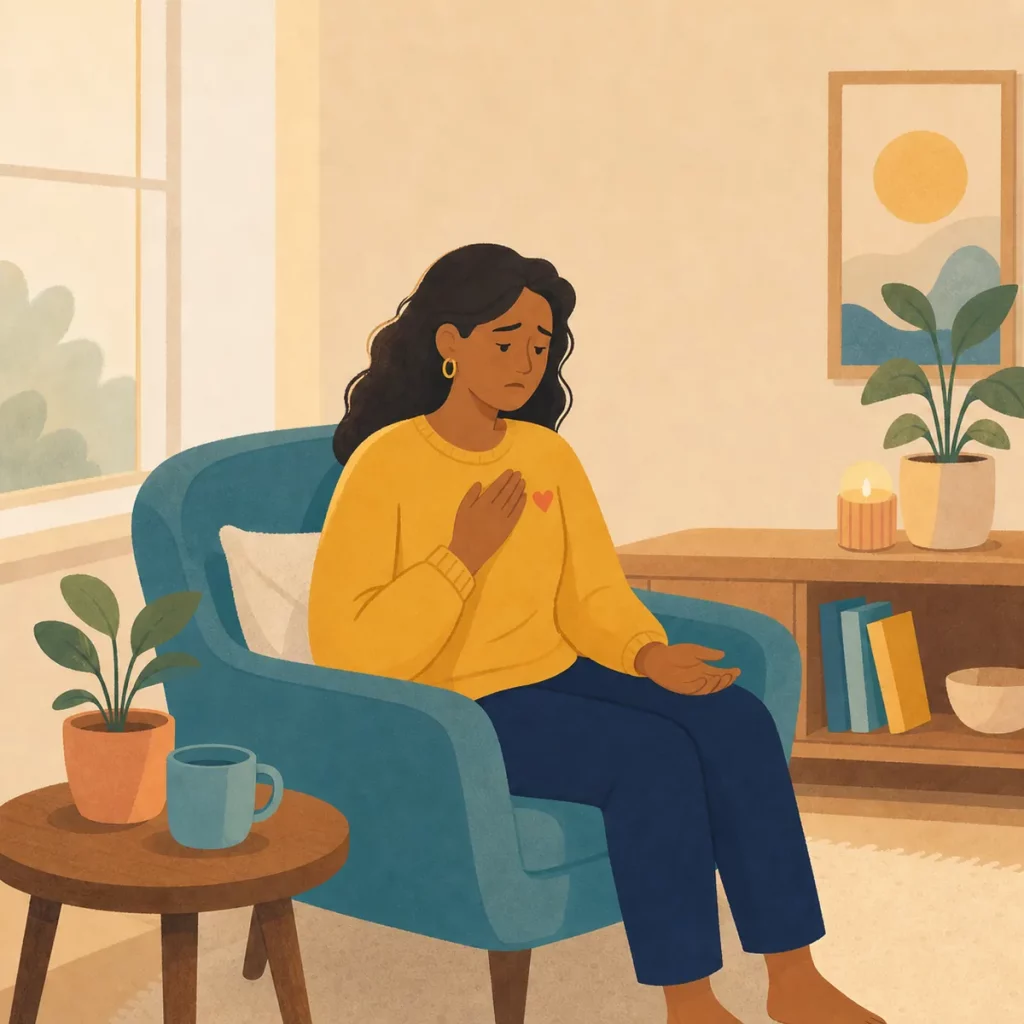
Why Health Anxiety Feels So Real (and Physical)
Health anxiety can involve very real physical sensations. Anxiety can change your breathing, heart rate, digestion and muscle tension. Noticing these changes may then intensify the fear that something is wrong. [1] [2] [3]
Attention matters too. When you are anxious, you may monitor internal sensations more closely, so ordinary changes feel louder and more threatening. Reassurance may help for a moment, but the anxious mind can quickly ask, “What if they missed something?”
A common loop looks like this:
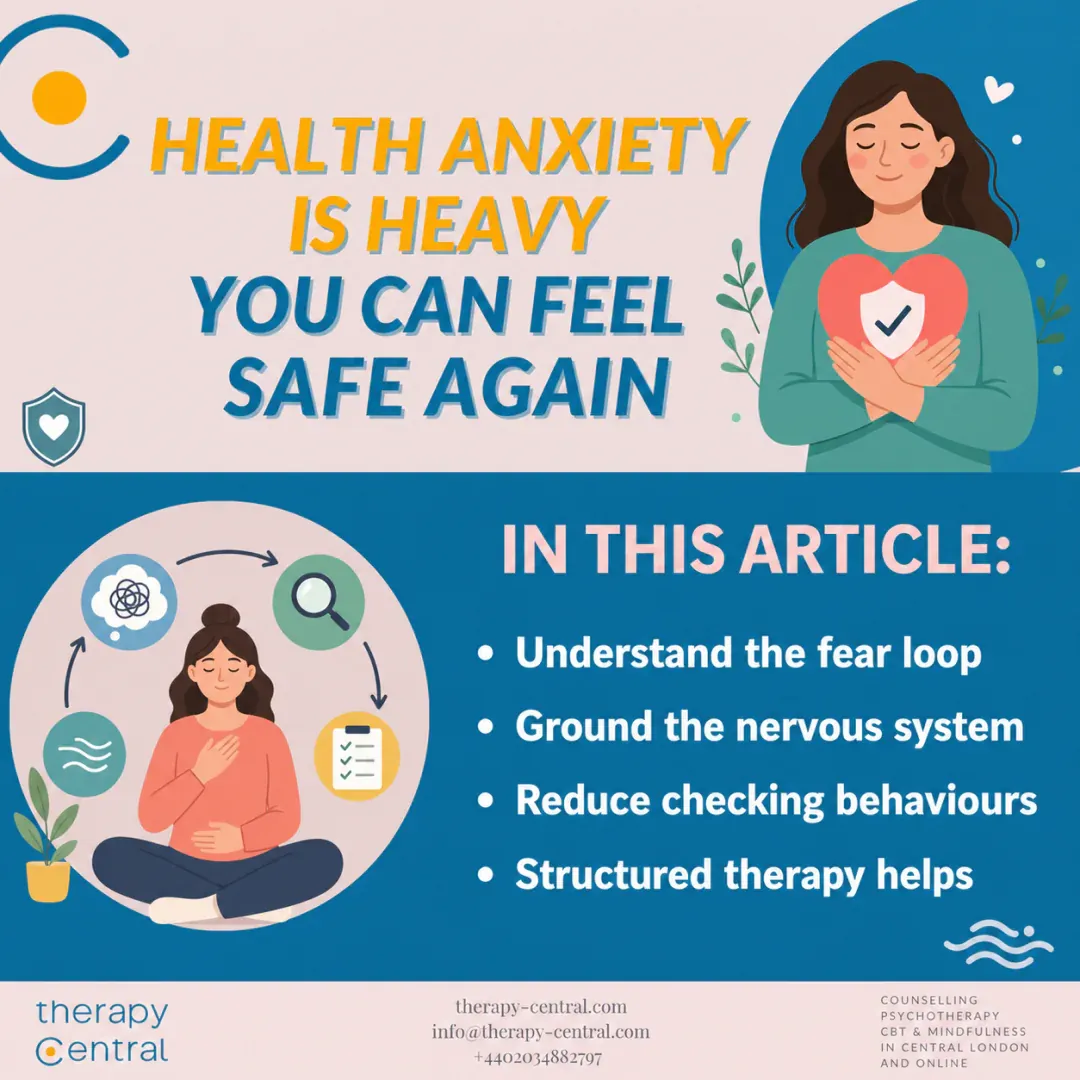
Trigger → Sensation → Catastrophic thought → Checking → Temporary relief → Rebound fear
Here is the same loop in a clearer visual format:
| Step | What happens | How it keeps the cycle going |
|---|---|---|
| Trigger | Sensation, thought, or health news | Sets off fear response |
| Sensation | Racing heart, tight chest, nausea | Feels like danger is real |
| Catastrophic thought | “Something is seriously wrong” | Raises panic intensity |
| Checking | Googling, body scans, doctor visits | Temporary reassurance |
| Rebound fear | Doubt returns | Cycle restarts |
Once a symptom has been appropriately assessed, the problem is likely not your body but an alarm system that has become too ready to interpret uncertainty as danger. Reassurance may calm that alarm briefly, but doubt can return with the next sensation.
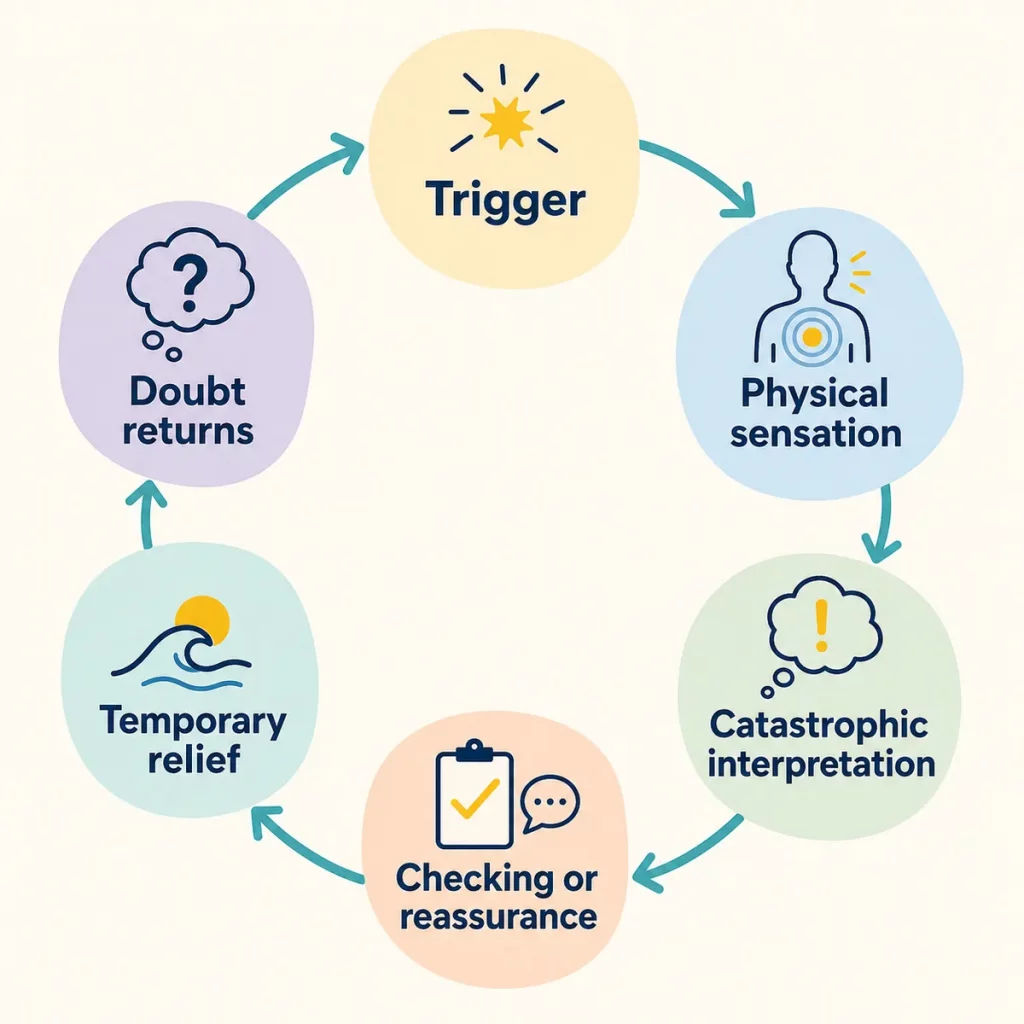
Health anxiety also narrows your attention. You start scanning for danger and may miss neutral evidence, which can make the fear feel even more convincing.
However, do not assume every symptom is caused by anxiety. Ask for medical advice when a symptom is new, severe, worsening or worrying. When the same concern has already been appropriately assessed, repeated checking and reassurance can keep the fear active. [1]
For a fuller explanation, read how health anxiety can cause physical symptoms.
Severe Health Anxiety Help: When You Feel Out of Control
If health anxiety feels out of control, start with immediate stabilising steps. These are not quick fixes, but practical ways to bring the intensity down enough so you can think clearly again:
- Slow the exhale. Try breathing in gently and allowing the out-breath to last a little longer for a minute or two. Do not force the breath. [4]
- Label the fear. Say: “This is health anxiety, not certainty.”
- Delay checking briefly. Start with a manageable delay rather than demanding that you stop completely in the middle of a panic spike.
- Ground your body. Plant your feet, press your hands together and look around the room.
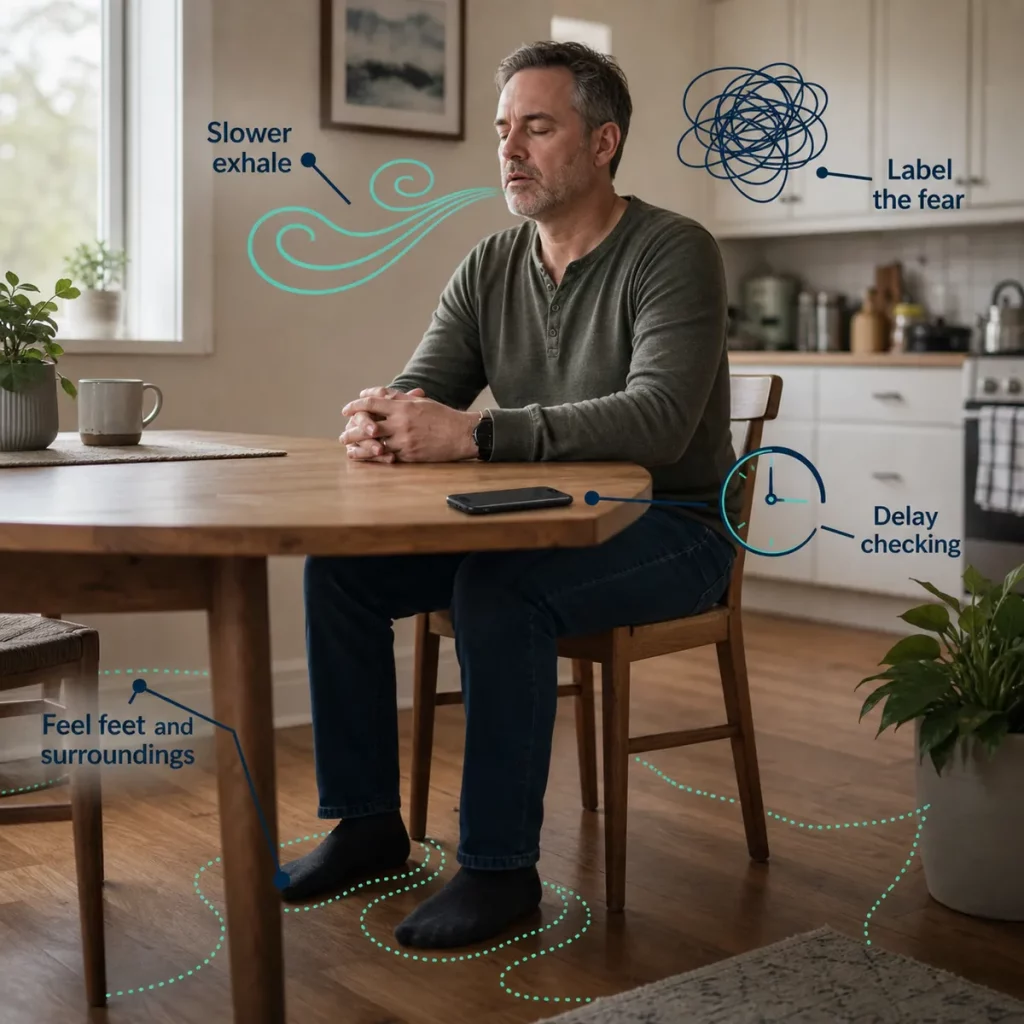
If you feel panicked, reach out to someone you trust.
If you need words to ask for help, try: “I’m struggling with severe health anxiety and I don’t want to handle it alone. Can you stay with me or help me get support?” Small, clear requests are easier than long explanations.
If the anxiety is constant, consider booking a GP appointment and bringing brief notes about the symptoms themselves, when the fear spikes, and the checking or reassurance behaviours that follow. This can help you discuss both your physical concerns and the anxiety pattern without assuming one explanation in advance.
Common behaviours to reduce include:
- repeated Google searches
- body scanning and pulse checking
- over‑monitoring apps or wearable devices
- asking multiple people for reassurance
- avoiding everyday activities “just in case.”
Reducing these behaviours gradually can help weaken the pattern over time. [2]
A helpful compromise is to create a short “reassurance window.” For example, you might allow yourself one planned 10-minute period each day to consider the concern and decide whether it genuinely needs medical advice, then practise postponing anxiety-driven checking at other times. This helps separate an appropriate healthcare decision from the immediate urge to search, check or ask for reassurance. [2]
When to Seek Urgent Support
Seek urgent mental-health support if you feel unable to keep yourself safe, think you may act on thoughts of self-harm or suicide, or are in immediate danger. In England, call NHS 111 and select the mental-health option. In an emergency, call 999 or go to A&E. You can also call Samaritans free on 116 123 at any time. [5] [6]
If health anxiety is stopping you from working, sleeping, eating or managing ordinary daily life, arrange non-emergency professional support promptly. You do not have to wait until you reach breaking point.
Breaking the Health Anxiety Cycle (CBT and Exposure)
CBT for health anxiety focuses on the point where fear turns into checking, avoidance or repeated reassurance. Rather than trying to guarantee that nothing is wrong, it helps you notice the interpretation you are making, test different responses and become more able to tolerate uncertainty. Research supports CBT as an effective treatment for health anxiety. [7] [8]
Key steps often include:
- Understanding the cycle. Seeing the pattern can reduce shame and confusion.
- Reducing reassurance and checking. These behaviours may bring brief relief while keeping the fear active.
- Using gradual exposure or behavioural experiments. You approach feared situations or sensations without relying on the same safety behaviours.
- Testing catastrophic thoughts. You consider more balanced possibilities without demanding absolute certainty.
The goal is to retrain your brain so sensations stop feeling like emergencies.
A useful CBT tool is response prevention: noticing the urge to check, delaying or choosing not to act on it, and observing what happens to the anxiety. The aim is not to force the fear away, but to learn that you can stay with uncertainty without automatically using the same safety behaviour.
A simple ladder might begin with reading a short piece of health-related information without continuing to search, then delaying a familiar checking ritual, returning to an avoided activity, or attending an appropriate medical appointment without repeatedly asking the same reassurance question afterwards.
In therapy, someone who fears that dizziness signals something serious might use a carefully chosen exercise to notice the sensation and practise not immediately checking their pulse or searching online. This would only be considered after relevant medical concerns and the person’s suitability had been assessed. The aim is not to prove that every sensation is harmless, but to weaken the automatic link between uncertainty and checking.
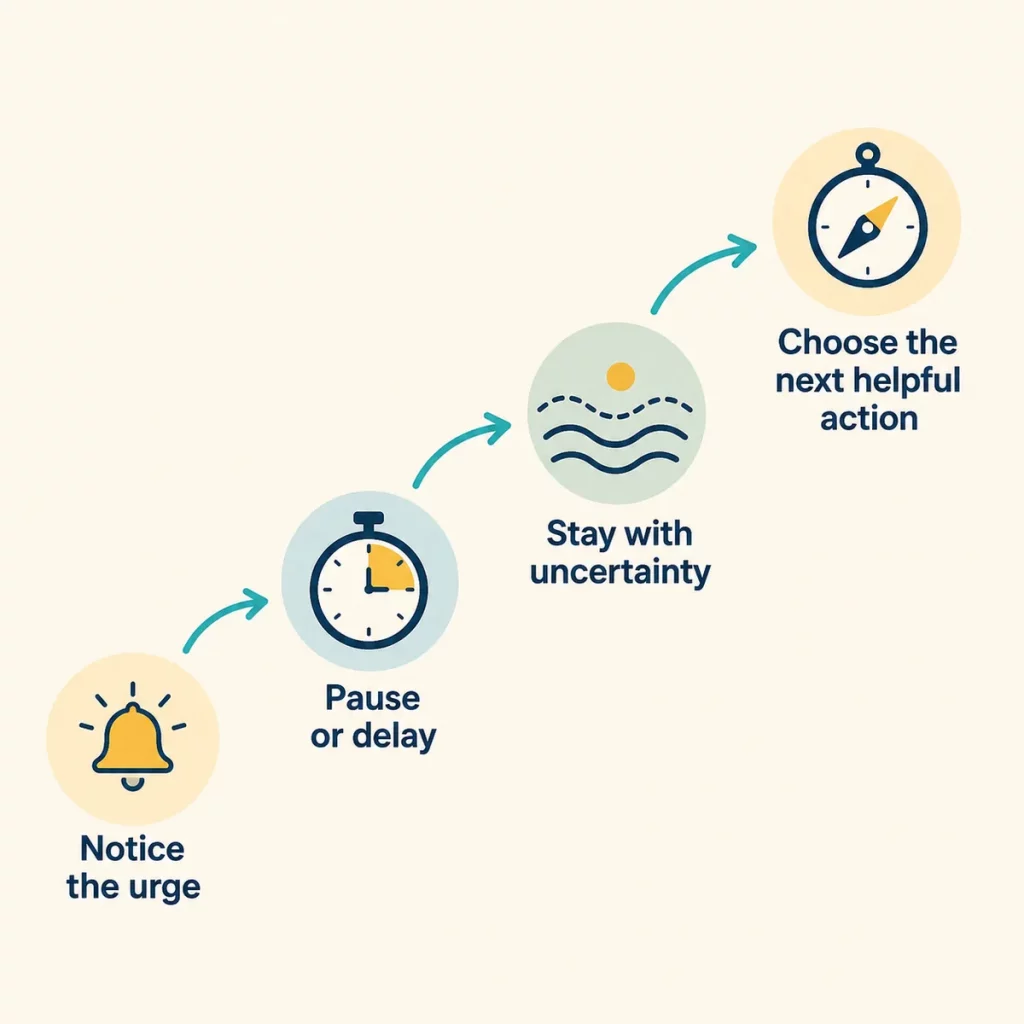
Health Anxiety Therapy UK: What Support Looks Like
In the UK, support may begin with a GP, NHS Talking Therapies or private therapy. CBT is one evidence-based treatment for health anxiety, but the work should be adapted to the person rather than applied as a fixed set of exercises. [1] [9]
Therapy is not simply about being told that a symptom is “just anxiety”. It should begin by understanding what has already been medically assessed, how your fears developed, what you do to obtain certainty, and which parts of your life have become organised around the anxiety.
Therapy may involve:
- building a shared map of your triggers, interpretations, physical sensations and safety behaviours
- distinguishing appropriate medical care from repeated anxiety-driven checking
- gradually reducing reassurance-seeking, avoidance and body monitoring
- using carefully planned behavioural experiments or exposure work
- understanding what makes uncertainty particularly difficult for you
- returning to relationships, activities and goals that anxiety has displaced
- preparing for setbacks without treating them as failure.
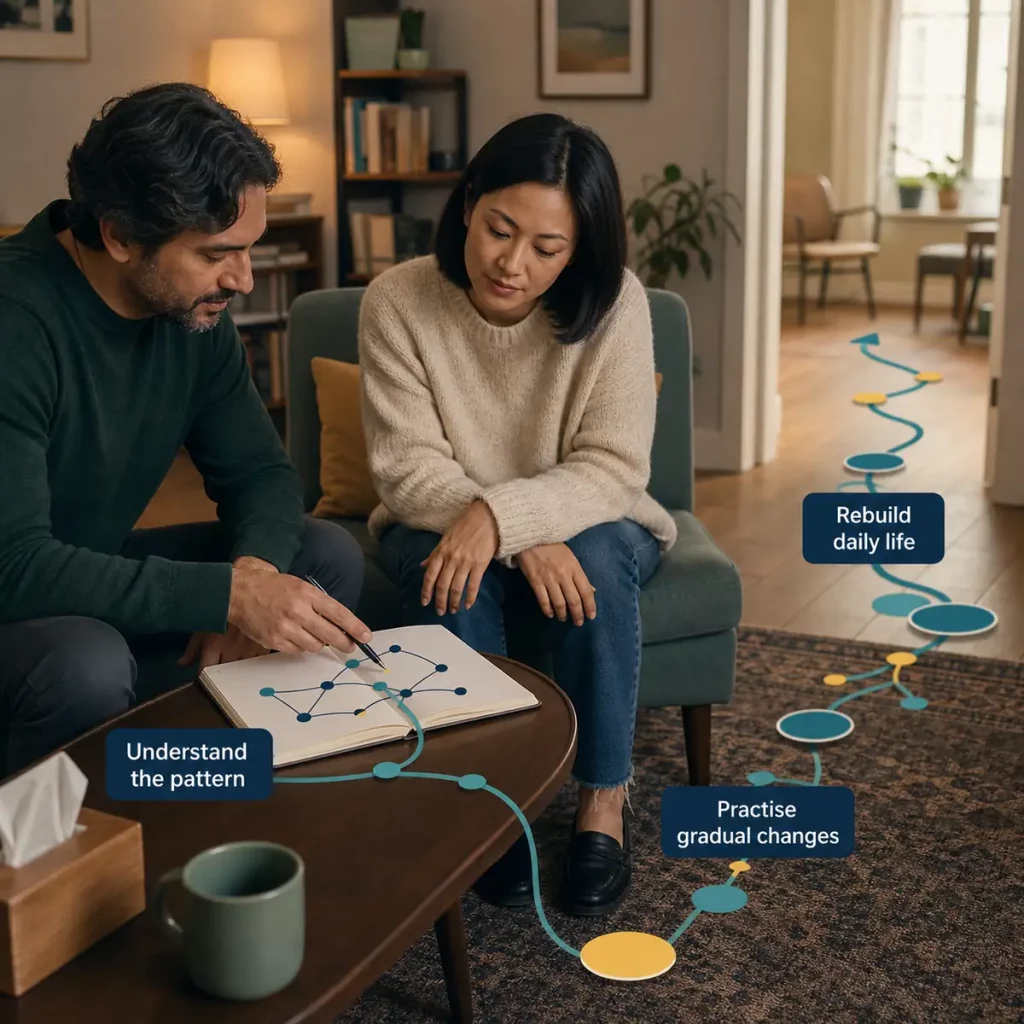
A therapist who understands health anxiety can adapt the pace and methods to your history, physical health and goals. Therapy should not require you to ignore your body or prove that nothing can ever be wrong. It should help you make decisions that are less dominated by fear and repeated reassurance.
If you are looking for structured support, learn more about our specialist health anxiety therapy.
Overcoming Health Anxiety in Daily Life
Recovery happens in daily micro-choices, not just in the therapy room. It also becomes visible when life begins to grow larger again, even before the anxiety has disappeared. Helpful practices include:
- using a planned reassurance window rather than checking whenever an urge appears
- building a steady morning and evening routine
- responding to frightening thoughts with “maybe, not certain” rather than demanding complete certainty
- returning gradually to people, places and activities that health anxiety has pushed aside.
Here is one way to organise those steps:
| In the moment | Daily practice | Rebuilding your life |
|---|---|---|
| Slow the exhale and feel your feet | Use the planned reassurance window | Return to one avoided activity |
| Label the fear without treating it as certainty | Briefly note triggers and checking urges | Be present with one person or meaningful activity |
| Delay anxiety-driven checking | Keep a gentle movement and sleep routine | Continue an agreed therapy or exposure plan |
Choose two tools to practise and one part of life to reclaim. Measure progress not only by how calm you feel, but by what you can participate in while uncertainty is present.
A helpful relapse plan is to decide in advance what you will do when anxiety spikes: for example, slow your breathing, delay checking, write down a concern for the reassurance window, or contact a supportive person. Planning while calm makes the steps easier to follow when you feel overwhelmed.
If someone close to you is involved, ask them to help you return to the plan or to ordinary life rather than repeatedly deciding whether a symptom is dangerous. That protects the relationship from becoming another reassurance ritual.
Slipping back into checking or reassurance-seeking can be part of the process. Progress is often uneven. A setback is information about what triggered the old pattern, not proof that you cannot change it.
When You Are Ready to Get Support
Health anxiety can make your world smaller while demanding more and more of your attention. Recovery is not about never noticing another sensation or never feeling afraid. It is about recognising the pattern sooner, responding differently, and making room again for work, relationships, rest and the parts of life that matter to you.
At Therapy Central, our therapists can help you understand what keeps your health anxiety active and develop a plan suited to your circumstances. You do not need to arrive certain that therapy is the answer; the first step can simply be a conversation about what has been happening.
If you would like to discuss whether our support could fit your needs, book a free 15-minute consultation.
FAQ
How Do I Know Health Anxiety Is Taking Over My Life?
Health anxiety may be taking over when checking, symptom research or reassurance consume substantial time; relief never lasts; and fear changes your work, sleep, relationships, appointments or everyday choices. The clearest sign is often how much life has become organised around avoiding uncertainty.
Is Health Anxiety a Real Condition?
Yes. Health anxiety is a recognised mental-health difficulty, and the distress and physical sensations can be very real. The problem is not that you are inventing symptoms, but that persistent fear, checking, avoidance or reassurance-seeking begins to interfere with daily life.
Can Severe Health Anxiety Be Treated?
Yes. CBT adapted for health anxiety has evidence of benefit, including for persistent difficulties. Treatment may involve understanding the fear cycle, reducing checking and reassurance gradually, testing catastrophic interpretations, approaching avoided situations, and rebuilding daily life.
What Helps When Health Anxiety Feels Out of Control?
Start by reducing the immediate intensity: slow the exhale, ground yourself in the room and label the fear as anxiety rather than certainty. Delay checking for a manageable period and follow a plan made while calmer. Seek professional or urgent support if you cannot function or keep yourself safe.
When Should I Seek Professional Help for Health Anxiety?
Consider professional help when health worries persist despite appropriate assessment, reassurance fades quickly, or checking and avoidance affect sleep, work, relationships or medical decisions. New, severe, worsening or worrying physical symptoms should still be discussed with an appropriate medical professional.