
If you are searching for how to deal with guilt, you are probably carrying something heavy. Maybe you keep replaying a mistake, feeling responsible for someone’s pain, or judging yourself harshly even when you have already apologised. Guilt can be useful – but it can also become crushing.
Sometimes you feel guilt in your body before you can name it – a tight chest, a heavy stomach, or a restless urge to fix what you can’t fix.
This guide will help you understand guilt, separate it from shame and regret, and learn practical steps to move forward. You will also find guidance for “confession‑free” guilt, self‑forgiveness, and when therapy can help. It can be reassuring to know this: guilt often means you care. The goal isn’t to become guilt‑free; it’s to respond to guilt in a way that leads to growth, not endless self‑attack. If you’re carrying that weight, the next steps can be small and practical.
How to Deal with Guilt
To deal with guilt, name what happened, separate responsibility from self‑attack, and take one constructive step (repair, learning, or a clear boundary). Then use self‑compassion to release what isn’t changeable. If guilt is persistent or intense, therapy can help.

Guilt is your mind’s way of saying, “Something matters here.” That can be helpful when it pushes you to make amends or align with your values. But when guilt turns into constant self‑punishment, it stops being useful and starts harming your wellbeing.
The goal is not to erase guilt. It is to respond to it in a way that leads to growth rather than endless self‑attack.
One quick check is this: is your guilt pointing to a clear action you can take? If yes, do the action and let the guilt soften. If no, it is often a sign that the guilt has become excessive.
For example, you might feel guilty for saying no to a family request even though you were exhausted. That feeling isn’t proof you did harm; it may be the old rule that your needs come last.
In moments like that, it can help to slow down and notice what you actually need.
What Is Guilt (and How Is It Different From Shame or Regret)?
Guilt, shame, and regret often overlap, but they are different emotional experiences. Guilt is about behaviour (“I did something wrong”), shame is about identity (“I am wrong”), and regret is about wishing you had chosen differently. 1 2
Here is a simple comparison:
| Emotion | Focus | Common thought | Helpful response |
|---|---|---|---|
| Guilt | Behaviour | “I hurt someone.” | Repair, learn, make amends |
| Shame | Identity | “I am bad.” | Self‑compassion and re‑framing |
| Regret | Decision | “I chose poorly.” | Reflection and better choices |
Understanding the difference helps you respond appropriately. Guilt can be resolved. Shame needs compassion. Regret needs learning.
Which article is more right for you? If your main question is “I wish I had chosen differently”, then the piece on dealing with regret may be more specific. If instead what you’re feeling is broader distress rather than guilt about responsibility or repair, then emotional pain may fit better. This article focuses on guilt as responsibility, repair, and self‑punishment.

Example: You forget a friend’s birthday. Guilt might sound like “I let them down.” Shame might say “I’m a terrible friend.” Regret might be “I wish I’d planned ahead.” The response is different for each – guilt invites repair, shame invites kindness, regret invites planning.
Healthy Guilt vs Unhealthy Guilt
Healthy guilt is proportionate and time‑limited. It nudges you toward accountability and repair. Unhealthy guilt is excessive, constant, or disconnected from the real impact of what happened.
| Type | Signs | Impact | Best response |
|---|---|---|---|
| Healthy guilt | Specific, short‑term | Motivates change | Repair and learn |
| Unhealthy guilt | Global, relentless | Drains confidence | Self‑compassion + boundaries |
If you are stuck in constant guilt, you are likely dealing with the unhealthy version – and it deserves care, not punishment.

Unhealthy guilt often grows in families or cultures where you were expected to keep everyone else happy. If you learned that being “good” meant never upsetting anyone, guilt can become your default – even when you’ve done nothing wrong.
Caregivers often carry this kind of guilt. You might feel responsible for other people’s comfort at all times. That is a heavy expectation – and it is not sustainable.
For a wider discussion of how values, intentions, and the impact of our actions shape morality, read Dr Raffaello Antonino’s interview on developing morality and judgement.
Why Guilt Sticks Around
Guilt tends to linger when:
- you expect perfection of yourself
- you believe you should always make others happy
- you replay the event repeatedly without resolution
- you fear being seen as “bad” or selfish.
Guilt also lives in the body. You might feel a tight chest, knots in your stomach, or a restless heaviness that won’t settle. 3 That physical charge can trick the mind into thinking you must keep punishing yourself to feel safe. Pausing to breathe, unclench your jaw, or place a hand on your chest can signal to your nervous system that you are not in danger right now – which makes clearer thinking possible.
Rumination is a big driver. The more you replay the story, the more guilt feels “true.” This is why breaking the rumination loop matters.
If you notice obsessive guilt or intrusive “what if” loops, CBT for anxiety can help you challenge these patterns. 4 5
Some people also experience “moral scrupulosity” – the feeling that they must be perfect or pure in order to be okay. That can keep guilt active even after repair. Recognising this pattern is the first step to loosening its grip.
If you grew up in a home where love felt conditional, guilt can become your default emotional state. In that case, the goal is to rebuild a fairer internal standard – one that allows mistakes without moral collapse.
Sometimes guilt shows up when you set a boundary or choose yourself. That doesn’t automatically mean the boundary is wrong. It can mean you are breaking an old rule that said your needs were less important. A useful question is: “Am I feeling guilty because I did harm, or because I disappointed someone?” Discomfort with disappointing others is not the same as wrongdoing.
How to Stop Feeling Guilty
People often want to know how to stop feeling guilty quickly. The first step is to slow the loop down.
One way to slow the loop is to separate feeling from fact. Say, “I feel guilty, but that doesn’t automatically mean I am guilty.” Then bring your attention back to the present moment. A short grounding routine – cold water on your wrists, a brisk walk, or slow breathing – helps your body exit the alarm response that keeps guilt loud.
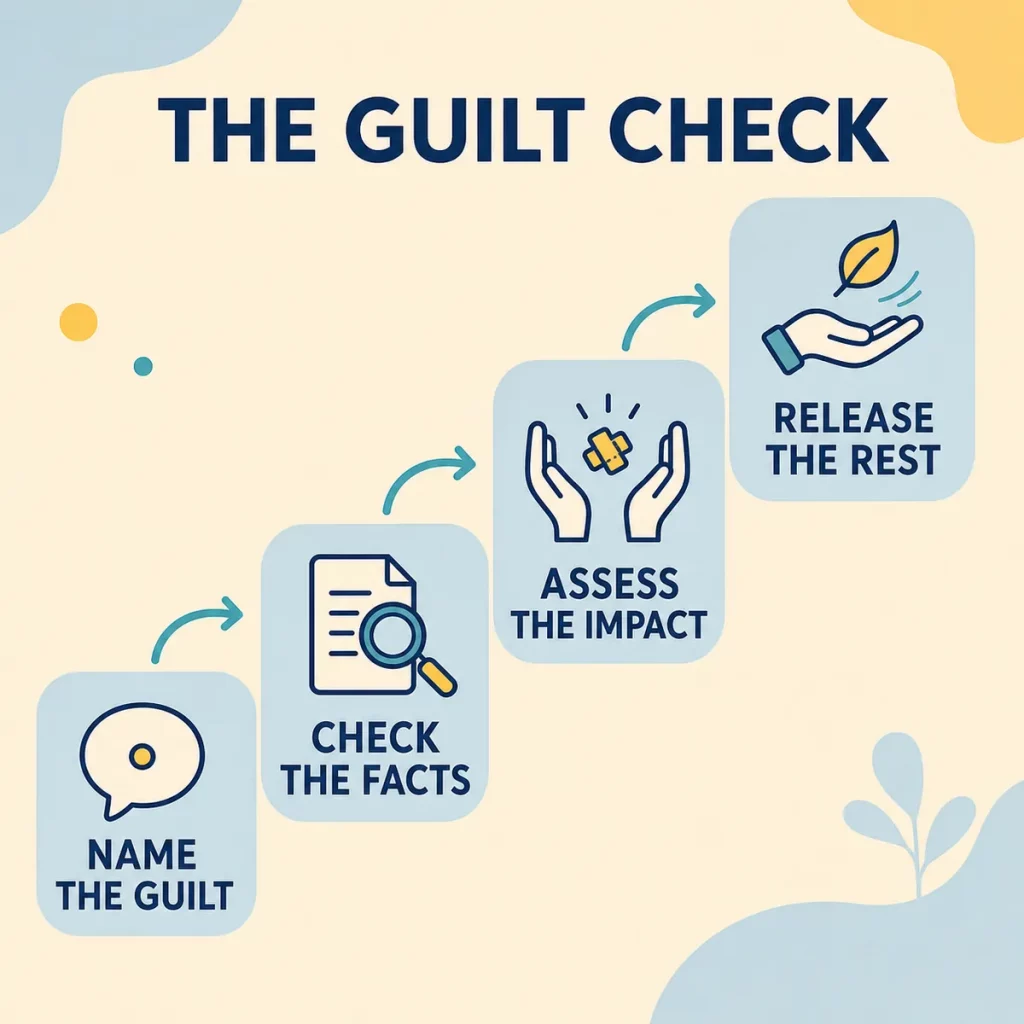
Try this:
- Name the guilt clearly. What exactly are you feeling guilty about?
- Check the facts. What did you actually do? What did you intend?
- Assess impact. Did harm occur? If so, how can you repair it?
- Release the rest. Anything beyond that is self‑punishment, not responsibility.
A practical way to stop spirals is to set a time‑limit: “I’ll reflect for 10 minutes, then I will return to the present.”
You can also add a compassionate phrase like, “I can take responsibility without attacking myself.” That simple shift helps the nervous system stand down.
If you are unsure whether the guilt is fair, try a “responsibility check”:
- What part is truly mine?
- What part belongs to circumstances or other people?
- What would I say to a friend in the same situation?
This helps you move from blanket shame to realistic accountability.
If guilt returns later, repeat the check once, then redirect to a concrete action that supports your values and reminds you the loop is over.
How to Get Over Guilt Without Denying It
Getting over guilt doesn’t mean pretending nothing happened. It means learning from the experience and then giving yourself permission to move forward.
Try this three‑step approach:
- Repair (if possible): apologise, make amends, or act differently next time.
- Reframe: separate the mistake from your identity.
- Re‑commit: choose the values you want to live by going forward.
This is how guilt becomes growth rather than a lifelong sentence.
If part of you keeps saying “I should suffer,” remember that suffering doesn’t undo harm. Repair and learning do. That is the difference between responsibility and self‑punishment.
For example, if you snapped at a friend, repair might be a sincere apology and a plan to pause before reacting next time. That is enough. Ongoing self‑punishment doesn’t add value.
How to Stop Feeling Guilty Without Confessing
Sometimes you can’t confess. It might not be safe, appropriate, or possible. That doesn’t mean you can’t heal.
In those cases:
- make indirect amends (e.g., act differently in future relationships)
- practise self‑compassion rather than shame
- write a letter you don’t send (to process and release)
- focus on what you can control now.
You are still allowed to move forward, even when confession is not possible.
If guilt feels tied to secrecy, writing the full story in a private journal can help your brain complete the loop. You don’t need to share it for it to be healing.
A Self‑Forgiveness Process That Actually Helps
Self‑forgiveness is not pretending nothing happened. It is choosing to live in a way that aligns with your values while letting go of constant self‑attack. A simple process looks like this:
- Acknowledge the harm without minimising it.
- Take responsibility for what is yours (not everything).
- Make repairs where possible.
- Practice compassion: speak to yourself like you would to a loved one.
- Commit to change and then let the past be the past.
Self‑forgiveness takes repetition. It is normal to need reminders.
If self‑compassion feels unfamiliar, self‑compassion tools can help you build that skill without forcing positivity.
A simple self‑forgiveness script can help: “I acknowledge what happened. I’m willing to learn from it. I will choose a kinder way forward.” It may feel awkward at first, but repetition builds trust.
If you made amends and changed your behaviour, continuing to punish yourself is no longer accountability – it is a habit. Replacing that habit with compassionate boundaries is part of the healing.
When Guilt Needs Therapy
If guilt is persistent, intense, or tied to trauma, therapy can help you unpack what is underneath. Persistent guilt and self‑blame can also be a symptom of depression. 6 This is especially true if guilt has become part of your identity or if you feel trapped in shame loops.

Psychodynamic therapy can help when guilt is tied to long‑standing self‑criticism, early relationship patterns, or a harsh internal standard. More broadly, therapy can help you separate responsibility from self‑punishment and rebuild self‑trust. 7 8 9
You might consider therapy sooner if:
- guilt keeps you awake or dominates your thoughts
- you apologise constantly even when you did nothing wrong
- you feel “bad” rather than simply “wrong”
- the guilt is linked to trauma or abuse.
If guilt shows up as intrusive thoughts or compulsive reassurance‑seeking, OCD support can help you break that loop.
Sometimes guilt can feel tied to a deeper sense that you violated your own values, which can also be seen as a moral injury. Therapy can help you work with that feeling without turning it into endless self‑punishment.
If you are ready for support, our qualified and experienced therapists and psychologists can help you move forward with compassion and clarity.
You deserve support that feels steady, respectful, and grounded in real change.
If you would like support, book a free 15-minute consultation.
FAQ
How to stop feeling guilty without confessing?
If confession isn’t possible or safe, focus on learning, making indirect amends, and practising self‑compassion. You can repair through future behaviour and boundaries.
How to stop feeling bad about something you did?
Acknowledge the impact, take a reparative action where possible, and challenge harsh self‑talk. Guilt becomes lighter when it leads to growth.
How to get rid of guilt?
You can’t erase guilt instantly, but you can reduce it by making amends, changing behaviour, and practising self‑forgiveness consistently.
How to not feel guilty all the time?
Excessive guilt often comes from perfectionism or anxiety. Ground yourself in realistic standards and limit rumination.
Is guilt always a bad thing?
No. Healthy guilt can guide repair and growth. It becomes harmful when it’s disproportionate or never resolves.