
Maybe you are about to say something heavy and you pause, wondering if it will stay in the room. That hesitation is normal. Searching client confidentiality is often a way of asking for safety before you open up.
This article explains confidentiality in counselling (and therapy) in plain language and outlines the UK limits. We try covering what’s protected, when information can be shared, how therapists keep records safe, and how to ask the right questions before you begin.
If you’re new to counselling, the how therapy works page can give you a clearer sense of the process.

What does client confidentiality mean in counselling?
Client confidentiality in counselling means that what you share stays private between you and your therapist, with a few clear UK exceptions for safety and legal obligations.
Client confidentiality in counselling means essentially that what you share stays private between you and your therapist (with a few, but clear UK exceptions for safety and legal obligations).
At its core, counselling confidentiality means your therapist does not share your personal information without consent.12
It exists to create safety and trust so you can speak honestly about your feelings, your past, your relationships, and anything else you bring to therapy. Your counsellor should explain what is covered, how notes are stored, and the limited situations where information may need to be shared.

Confidentiality in Counselling Definition
A simple definition of confidentiality in counselling is: personal information shared in a therapeutic relationship is protected and only disclosed for clear, limited reasons. It covers what you say, what your therapist notices, and what is recorded in notes.
It isn’t the same as legal privilege, but it is a professional promise you should be able to rely on.
Confidentiality in Psychology Definition
The definition of confidentiality in psychology is very similar.12 It means protecting personal information except in specific, limited circumstances.
Whether you are seeing a counsellor, psychotherapist, or clinical psychologist, the expectation of privacy applies. Psychologist confidentiality follows the same principle: protect information, disclose only when legally or ethically required, and be transparent about limits.3
Why confidentiality matters in therapy
Therapy works when you feel safe enough to be honest. Confidentiality creates that safety.
It helps you:
- Share feelings that feel embarrassing or hard to name
- Talk openly about relationships, trauma, or identity
- Explore patterns you have never spoken about before
- Trust that your therapist will treat your words with care.
Health and Care Professions Council guidance notes that service users expect confidentiality and that breaking it can affect care.1
Confidentiality protects the therapeutic relationship itself. Clear boundaries reduce self‑censorship so therapy can focus on what is real. In the UK, confidentiality is supported by professional ethics and data protection law, which adds an extra layer of accountability.5
What is covered by confidentiality (and what isn’t)
Most of what you say in counselling is confidential. That usually includes:
- Personal history and life events
- Emotions, thoughts, and symptoms
- Relationship difficulties and family dynamics
- Experiences of trauma or abuse
- Identity, sexuality, or cultural concerns.
It also includes things your therapist observes in the room, such as how you react to a topic or what helps you calm down. Confidentiality is broader than “what you said.” It includes the whole therapeutic picture.
It can also cover information about other people you mention, but therapists do not contact third parties without consent.
Counsellor Confidentiality in Practice
Counsellor confidentiality means therapists cannot casually share information with employers, family members, schools, or friends. If they discuss your case in supervision, they do so without identifying details.
So what is not covered? The limits are narrow but important. If a therapist believes someone is at serious risk, they may have a legal or safeguarding duty to act. This is why it helps to understand the exceptions before therapy begins.
You will usually see these limits written clearly in a therapy agreement or consent form.2
When can confidentiality be broken in the UK?
A common question is: when does a therapist have to break confidentiality in UK? The answer is that this happens only in very narrow and clearly defined situations tied to safety or law.
Examples include:
- Immediate danger to you or someone else
- Safeguarding duties involving a child or vulnerable adult
- Legal obligations, such as a court order or specific legal reporting duty
- Public-interest concerns, such as preventing serious harm or serious crime.
It helps to separate two ideas. Some disclosures are legally required, for example when a valid court order applies or when a specific law creates a duty to report. Other disclosures have more to do with professional judgement, safeguarding procedures, or public-interest decisions about serious risk. In either situation, the aim should still be to share only what is necessary and to be as transparent with you as possible.34
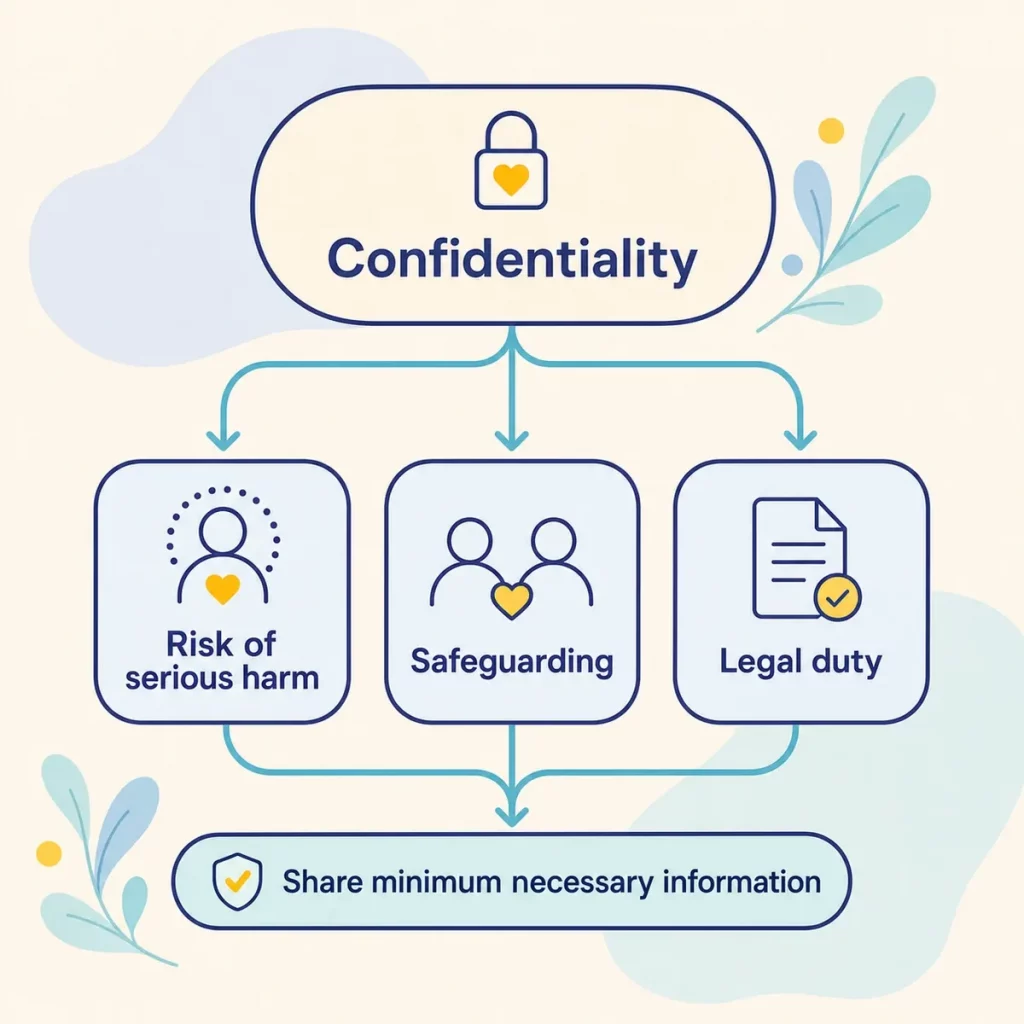
The guiding principle is safety. Therapists should explain these exceptions clearly and aim to share the minimum information needed. These rules around breaking confidentiality are usually also part of the onboarding process in therapy, including for instance in a therapy contract you might sign. Your therapist is also likely to explain these limits at the very start of therapy.
If disclosure is required, a therapist will usually try to:
- Speak with you first and explain the concern
- Disclose only what is necessary for safety
- Tell you what will be shared and with whom.
This reflects guidance on minimising disclosure and informing people using therapy services where possible.34
| Situation | What It Means | Typical Action |
|---|---|---|
| Serious risk to self or others | Immediate, credible danger | Share limited information with appropriate services |
| Safeguarding concern | Child or vulnerable adult at risk | Follow safeguarding procedures and inform relevant authorities |
| Legal requirement | A court order or other specific legal duty applies | Provide only the information required within the scope of the duty |
| Public-interest or serious-harm concern | A credible risk means disclosure may be needed to protect someone | Consult policy/supervision where possible, then disclose the minimum necessary details |
Safeguarding, risk, and legal duties
Safeguarding has to do with protecting people who may be at risk, especially children and vulnerable adults. If a therapist believes there is immediate danger, they may have to act even if that breaks confidentiality with you.4
That does not mean that every difficult disclosure is reported. Therapists will always assess risk carefully and usually talk with you first to agree on what’s the safest next step. It’s really helpful here to remember that safeguarding is about care, not punishment, and the aim is to protect safety and at the same time preserving trust.4
If a legal duty applies, the focus is proportionality: share only what is necessary, and be transparent wherever possible.5 BACP guidance gives examples of legal obligations, including court orders and some situations involving terrorism, drug trafficking, or money laundering.4 This is also where the difference between confidentiality and legal privilege matters.
Confidentiality vs Legal Privilege
In law, legal privilege can protect communications from being disclosed in court.7 Confidentiality in counselling is a little different. It is indeed a protection, but more from a professional and ethical duty perspectives, not an absolute legal shield. It means that disclosures can happen in specific circumstances, which we discuss in this article. This distinction can feel disappointing, but it is also what allows therapists to act when safety is at risk.
In practice, the vast majority of therapy conversations stay private, and exceptions are rare.34
What happens in your first session: confidentiality explained
A good first session should generally include a clear confidentiality conversation. You can expect your therapist to:
- Explain the limits of confidentiality in the UK
- Describe how notes are stored and who can access them
- Outline how supervision works (usually anonymised)
- Invite you to ask questions before you begin.
If you are preparing for therapy more generally, our first therapy session guide will walk you through what usually happens at the start and the kinds of questions you can bring with you.
If anything is unclear or you have doubts about confidentiality and how things work, always feel free to ask. Therapists expect these questions and in fact appreciate them because it shows you are taking care of yourself.
In that first chat, you might ask about the limits of confidentiality, or how notes are stored. You might also ask about how supervision works, and whether information is ever shared with a GP or other service.
How counsellors protect your information
Confidentiality in counselling is not just a promise. It is backed by various systems and processes that protect your information every day.
Some common safeguards include:
- Secure, password‑protected notes
- Limited access to records
- Encrypted or secure online platforms
- Compliance with UK GDPR and professional standards (e.g., HCPC, BACP, BPS, UKCP and so on, depending on the professional affiliations of your practitioner).
Therapists are expected to keep records secure and share information only with your consent or if legally required, in line with professional guidance and data‑protection rules.256 Moreover, professional guidance emphasises that any sharing should be relevant and limited to what is necessary.3
UK GDPR does not set one universal retention period for therapy records. At Therapy Central, clinical session notes are held by the treating associate practitioner, who is responsible for keeping them in line with their professional, legal and insurance obligations. Therapy Central holds limited administrative information needed for enquiries, matching, initial consultations and billing. You can ask your therapist what clinical records they keep and for how long, and ask Therapy Central separately about the administrative information it holds.8910
Supervision is also a very important part of ethical practice. Counsellors, therapists, psychologists and so on, of any level and experience, may discuss their cases with a supervisor to support safe and responsible work, but even supervision should sit within the same professional confidentiality framework and is usually anonymised or limited to what is necessary.2
| Who Might Receive Information | When It Could Happen | How Privacy Is Protected |
|---|---|---|
| Supervisor | For clinical support and safety | Case is anonymised, no identifying details |
| GP or other professional | With your consent, or if required for safety | Shared information is limited and relevant |
| Police or courts | Only when legally required or risk is severe | Minimum necessary disclosure |
| You (the client) | If you request access to records | Records provided under data protection rules |
If therapy is funded by an employer, EAP, insurer, or another third party, ask what information is shared with the funder. Administrative details, such as attendance, authorisation, or the number of sessions used, may be needed for billing or approval. This is different from clinical notes or the details of what you discuss in therapy. In some cases, a therapist may need to provide a brief report, for example to request more funded sessions, but this should usually be limited to relevant information rather than a detailed account of your sessions.
Confidentiality in online therapy and data protection
Online therapy can be just as secure, but it depends on how data is handled. If you are working online, it is reasonable to ask about the platform, encryption, and how your information is stored.
Look for signs of good practice, such as:
- Secure, private video platforms
- Clear privacy policy and data retention information
- Transparent consent forms
- Guidance for finding a private space at home or at work (if you are seeing your therapist from the office)
If you’re considering online counselling, you can ask about the platform and privacy practices upfront.

How to ask questions about confidentiality
You are absolutely allowed to ask questions about confidentiality at any point, not just in the first session. If you feel nervous about this, keep it practical and to the point. For instance you could say:
- “What would make you break confidentiality?”
- “Would you tell anyone if I spoke about past self‑harm?”
- “Can I read my notes if I want to?”
- “How long do you keep records after therapy ends?”
Of course, you don’t need to ask all of these at once. Choose the question that would make therapy feel safer or clearer for you.

If your therapist answers defensively or avoids the conversation, that is useful information. Feeling respected and informed is part of good care.
Clinical note from Dr. Raffaello Antonino, HCPC registered Counselling Psychologist
When a client asks about confidentiality, I would not see that as a nuisance. I would see it as useful material for therapy. Beyond the legal question, the person is often asking whether this new relationship can be trusted, and whether what they share will be treated with care and compassion. Therapy does stay private, and the rare limits are there to protect safety, not to take control away from the client. If you feel unsure, say that. You are not there to perform for the therapist or make the therapist’s job simple. Asking about confidentiality can be a first act of agency, and the beginning of a working therapeutic alliance.
When to seek extra support or make a complaint
If you believe your confidentiality has been breached without a valid reason, you have options. You can raise concerns directly with the therapist, or contact their professional body for guidance.
In the UK, this might include bodies such as BACP, UKCP, HCPC, or the BPS, depending on your therapist’s registration. If you are unsure which body applies, your therapist should be able to tell you.
If you decide to make a complaint, it can help to write down what happened, when it happened, and how it affected you. Having clear notes will make the process feel less overwhelming.
It is okay to change therapists if you do not feel safe or listened to. A good fit matters, and confidentiality is part of that fit.
If you want a space where confidentiality is clear and you feel safe, understood, and informed, we are here to help.
If you’re considering therapy and want a safe, respectful space, request a free 15-minute consultation.
FAQ
What can a therapist disclose in the UK?
Only limited information when there is serious risk of harm, safeguarding concerns, or a legal requirement such as a court order or specific reporting duty. Therapists can also disclose if you explicitly consent to that, for instance, with your GP, employer or family member.
Is counselling confidentiality the same as legal privilege?
No. Counselling confidentiality is professional and ethical, while legal privilege is a specific legal protection for solicitor‑client communications.
Can a therapist tell the police?
Only if there is a serious and immediate risk, or a legal obligation to disclose. Therapists should explain what they can and cannot share.
Do therapists share notes with anyone?
Notes are kept securely and are not shared without consent, except for legal or safeguarding duties. Supervisors may discuss cases without identifying details.
What if I’m worried about confidentiality?
Ask directly in your first session. Your therapist should explain limits clearly and give you space to decide what feels safe to share.