
Maybe the most frustrating part is that you have talked about it. Not once. Not vaguely. You may have explained, listened, apologised, tried again, and still ended up in the same place a few days later.
The problem may not be a lack of words. Sometimes the conversation has become too loaded to do its job. A look, a pause, a half-answer, or a familiar tone can start the whole sequence before either partner has really chosen it. The subject changes, but the route through the argument feels painfully familiar.
This article looks at the pattern underneath the words: why couples keep having the same argument, how emotional safety changes the conversation, what can help break the cycle, and when couples therapy may help.
Why Do The Same Arguments Keep Happening?
Couples often keep having the same argument because the topic changes but the underlying pattern does not. Criticism, defensiveness, pursuit, withdrawal or escalation can trigger one another before either partner feels heard. Breaking the cycle begins with noticing the sequence, slowing it down and making repair safer.
Signs You Are Stuck In The Same Communication Cycle
A repeating argument cycle is not only shouting, interrupting, or refusing to speak. It can be the small moment when one partner asks, “Are you okay?” and the other says, “I’m fine” in a way that clearly means they are not. It can be the practical chat about bills that somehow becomes a verdict on who cares more.
The visible signs are often easy to name:
- criticism that sounds like a complaint but lands as an attack
- defensiveness that arrives before the other person has finished speaking
- silence that feels less like reflection and more like punishment
- apologies that calm the evening but do not change the next argument
- sarcasm, eye-rolling, or contempt when one partner feels cornered.
The quieter signs can be harder to spot. Someone gives short answers because they are trying not to escalate. Someone avoids a subject because they cannot face another three-hour conversation. Someone agrees too quickly, then carries the resentment into the next day.
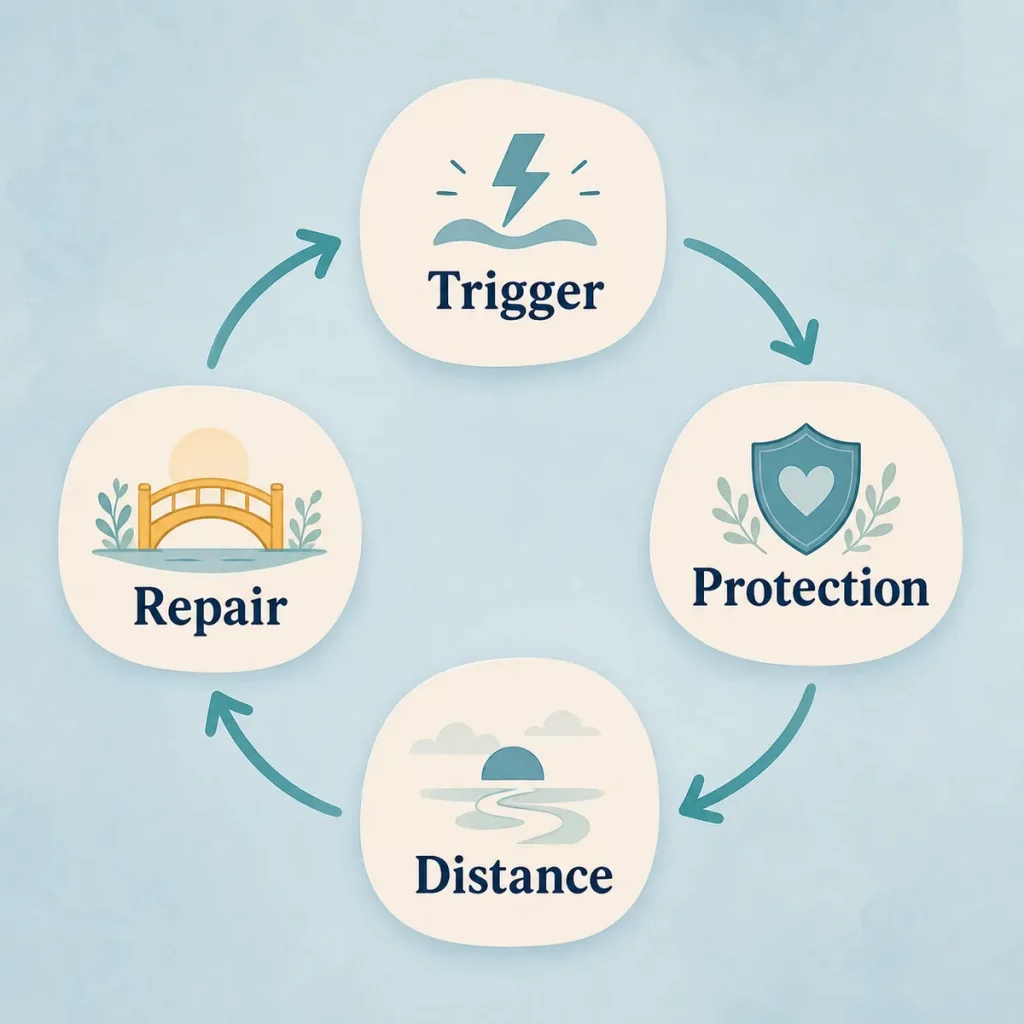
In other words, communication carries more than information. It also carries the question: “Are we safe with each other right now?” When the answer feels uncertain, both partners may start protecting themselves. One pushes for reassurance. The other retreats to avoid making things worse. 1 The more each person protects themselves, the less protected the relationship feels.
That can be especially confusing when both people are, in their own way, trying to protect the relationship. The partner who keeps asking may be trying to stop the distance growing. The partner who goes quiet may be trying to stop the argument getting worse. The intention can be protective, while the impact still feels lonely, critical, or cold.
If the difficulty is less about repeated arguments and more about silence, avoidance, or struggling to express what you need, our guide to lack of communication in a relationship covers those wider signs, causes, and effects.
Why Talking More Does Not Always Fix The Pattern
More talking can help when the issue is genuinely unclear. A couple may need to ask for what they want more directly, listen without interrupting, or choose a better time.
But if the conversation itself has become threatening, more talking can simply give the old pattern more room to run.
Imagine one partner says, “You never tell me what you’re thinking.” Underneath, they may mean, “I miss you and I do not know how to reach you.” The other partner hears, “You are failing again.” They defend themselves, explain their intentions, or go quiet. Now the first partner feels dismissed and pushes harder. The second feels trapped and pulls further back.
Nobody has to be cruel for this to hurt. The words have become shortcuts to older fears:
- “I am being blamed.”
- “I am being abandoned.”
- “I will never get this right.”
- “If I say the wrong thing, this will get worse.”
- “If I stop pushing, nothing will change.”
That is the difference between more words and a safer sequence. More words can fill the room. A safer sequence changes what both partners expect will happen next.
Common Communication Loops That Keep Couples Stuck

Most couples do not have a single communication problem. They have a repeatable sequence. Once it starts, each person’s reaction makes sense from inside their own nervous system, but it still makes the next reaction more likely.
The table below is not meant to diagnose the relationship. Use it to slow the pattern down enough to see it.
| Communication Loop | What It Can Look Like | What May Be Happening Underneath | Safer First Move |
|---|---|---|---|
| Criticise and defend | One partner raises an issue as a complaint; the other explains, corrects, or counter-attacks | Both feel misread: one as uncared for, the other as blamed | Start with one specific moment and one feeling |
| Pursue and withdraw | One partner pushes for a conversation; the other becomes quiet, vague, or unavailable | One fears distance; the other fears escalation | Agree a time to return, rather than forcing it now |
| Escalate and shut down | Voices rise, then one person freezes or leaves | The nervous system is overwhelmed | Take a timed pause and name when you will come back |
| Repair and repeat | You apologise, reconnect, then find yourselves back in the same place | The apology soothed the rupture but did not change the sequence | Ask, “What happened just before we got stuck?” |
| Mind-read and resent | One partner expects the other to know what is wrong; the other misses the cue | Needs are being protected from possible rejection | Make the request smaller and more direct |
For many couples, arguments in the relationship become predictable: the topic changes, but the route through the argument stays almost identical. 1
When you can more or less script the next five minutes, a better question than “what are we arguing about” is “What happens to us once this topic appears?”
What Helps Communication Feel Emotionally Safer

Safer communication builds enough steadiness that both people can stay in the room psychologically, even when the subject is uncomfortable. Nobody has to speak softly forever, dodge hard topics, or pretend to be calm.
That steadiness is often created through small choices rather than one perfect conversation.
Start Smaller Than You Think You Need To
When people feel hurt, they often start at the size of the pain: “You never listen” or “You always make me the problem.” The pain may be real. The opening still gives the other person very little room to hear it.
Try starting with one moment:
- “Yesterday, when I was talking about work and you looked at your phone, I felt brushed off.”
- “When we stopped talking after dinner, I felt the distance between us.”
- “I want to explain this without blaming you, because I think we keep missing each other.”
Smaller does not mean watered down; it just gives the other person a better chance of understanding what hurt.
Separate The Issue From The Pattern
The issue might be money, housework, sex, parenting, family, time together, or phones. The pattern is what happens once you try to discuss it.
Ask:
- What is the topic?
- What do I usually do when this topic appears?
- What does my partner usually do next?
- How do we normally end the conversation?
This can lower the temperature in the room. Instead of two people collecting evidence against each other, the couple starts studying the sequence between them. That is often less shaming, and much more useful.
Use Pauses As Repair, Not Escape
A pause helps only when both partners know it is a pause. Without a return point, a break can feel like abandonment to one person and relief to the other.
A clearer version might be: “I am getting overwhelmed and I do not want to say this badly. Can we pause for 20 minutes and come back at 8?”
That sentence does two things. It protects the conversation from escalation, and it protects the bond from disappearing while one person regulates. 2
Repair The Emotional Moment
Repair is not only an apology. It is any signal that the relationship still matters while the disagreement is unresolved.
It might sound like:
- “I said that too sharply. Let me try again.”
- “I can see why that felt dismissive.”
- “I am not against you. I am struggling to explain this.”
- “I want to understand before we solve it.”
These small repairs matter because many couples do not only fear the disagreement. They fear what the disagreement seems to prove about the relationship.
That is why repair often needs to be ordinary and immediate. A small correction in tone, a sentence that shows you have heard the other person, or a clear return after a pause can stop the argument becoming evidence for a bigger story. Without repair, that story can start to sound like proof that one of you does not care, cannot listen, or might leave again.
When Couples Therapy May Help

Couples therapy may help when sincere effort keeps turning into the same outcome: one person hurt, one person defended, and both feeling more alone than before. 3
The goal is not to find the guilty partner. More often, the work is to slow the loop down while it is happening, so each person can notice what they do, what they fear, and what their response is doing to the other.
In couples therapy, a therapist can help partners make sense of the pattern without making either person the whole problem. 4 The work may involve clearer requests, less blaming starts, better pauses, and repair attempts that actually reach the injury. 5
This is couple-level support rather than a private attempt to coach one partner into speaking “better”. The focus is on what happens between you: who moves towards, who moves away, when the conversation becomes too much, and what would help each of you return without feeling defeated or exposed.
It can also help a couple decide what kind of support they need. Some couples are working on communication habits. Others are dealing with deeper wounds, trust concerns, or patterns where one partner does not feel safe. Those may need a different pace, and sometimes separate support, before joint conversations can be useful.
How To Stop Having The Same Argument

If you are wondering how to stop arguing in a relationship, it can help to think less about the perfect wording and more about the conditions around the conversation. Many arguments do not start because the topic is impossible. They start because the couple enters the topic already tired, defended, or braced for impact.
Use this as a simple reset:
| Moment | Helpful Action | Why It Helps |
|---|---|---|
| Before talking | Ask, “Is now a good time for something a bit difficult?” | It gives the other person a chance to be present rather than ambushed |
| At the start | Name one issue and one feeling | It keeps the conversation from becoming a full relationship audit |
| When emotion rises | Pause for a set time and agree when to return | It protects the conversation from nervous-system overload |
| When blame appears | Return to the specific moment | It keeps the topic concrete and easier to repair |
| After the conversation | Say one thing you understood | It helps the conversation end with connection, not just exhaustion |
The table stays simple on purpose. When a couple is activated, complicated plans usually disappear. A few agreed moves are easier to remember.
You might also agree on a few couple-specific limits:
- no serious conversations after midnight
- no following someone from room to room
- no bringing in five old examples
- no using silence to punish
- no pretending a pause means the issue is gone.
These limits give both people a better chance of staying respectful when emotions run high.
It can also help to agree what “coming back” looks like after a pause. Some couples need a specific time. Some need a gentler first sentence. Some need a quick reassurance that the pause is not a threat to the relationship. Without that agreement, one person’s healthy regulation can feel like the other person’s disappearance.
Getting Support When The Pattern Keeps Returning
Sometimes couples try very hard and still feel stuck. They read, listen, make promises, and mean them. Then something small happens and the old pattern arrives before either person can catch it.
At that point, the question may need to change from “Why can’t we communicate?” to “What happens between us when we try?”
That question is less blaming. It also points towards a more workable task: understanding the sequence, softening the protective moves, and finding ways to repair before the conversation collapses completely.
At Therapy Central, we support couples who want to understand their communication patterns and find more constructive ways to talk. If the difficulty sits more broadly across the relationship, Relationship Counselling may also be a relevant route to think about. Sessions are available online and in London, with flexible times where possible.
If communication keeps turning into the same painful loop, we can help you slow the pattern down and decide what kind of support makes sense. Contact us for a free 15 min consultation.
FAQ
Is It Normal For Couples To Have The Same Argument Repeatedly?
Yes, recurring arguments are common, but repetition usually means the underlying pattern has not changed. The subject may be money, chores, sex, parenting, or family, while the same sequence of criticism, defence, pursuit, or withdrawal keeps returning. What matters is whether you can repair, understand each other, and change what happens next.
How Can We Stop An Argument Before It Escalates?
Notice the earliest signs that either of you is becoming defensive, overwhelmed, or focused on winning. Name the need for a pause, agree exactly when you will return, and restart with one issue and one feeling. A pause should protect the conversation, not end it or punish the other person.
What If My Partner Shuts Down During Arguments?
Do not force an immediate response while either of you is overwhelmed. Agree on a specific time to return and explore what makes the conversation hard to stay with. If silence is being used to control, frighten, or punish, treat that as a wider relationship-safety concern rather than only a communication problem.
Can Couples Therapy Help Us Break An Argument Cycle?
Yes, when both partners can participate safely. Couples therapy can help you slow the sequence down, notice what each person fears or protects against, practise less blaming starts, and make repair attempts that reach the underlying hurt.
When Is Repeated Arguing More Than A Communication Problem?
If arguments involve fear, threats, intimidation, coercive control, or violence, the priority is safety rather than improving communication as a couple. Consider specialist individual support, and seek emergency help if anyone is in immediate danger.